


A slot machine is also called a casino machine, gambling machine or, in the UK, a fruit machine. It’s a game where you spin reels of symbols and win if matching symbols land on a payline. But how do slot machines work? Every spin is decided by a random number generator (RNG) the moment you press the button, so each result is independent of the last. In this guide, we explain RNG, RTP and volatility, and how paylines and symbols work. Moreover, we debunk the most common slot machine myths.
What Is a Slot Machine?
To answer what is a slot machine in simple terms, it’s basically a popular, automated gaming device. Players bet on random symbol combinations to win. To trace the history of slots, we must go back to the late 1890s and Charles Fey’s Liberty Bell. This machine had three reels with symbols like horseshoes, diamonds, and the iconic Liberty Bell. Players pulled a lever to spin the reels physically, so slots were called “one-armed bandits”.
Today, however, slot machines are land-based and online. While early machines used physical reels and levers, modern slots are digital. From the 1970s and 1980s, video screens and random number generators gradually replaced mechanical parts, and the first online slots appeared in the mid-1990s. Land-based slots are popular, but online slots add convenience, letting players enjoy games from home.
How Do Slot Machines Work?
With slot machines explained, let’s understand how slots work by studying them in detail.
Random Number Generator (RNG)
A Random Number Generator (RNG) is a software algorithm that constantly produces thousands of random numbers per second. Then an algorithm assigns probabilities to each potential outcome, ensuring each spin is fair and unpredictable.
Note that the result of a slot game is determined the moment you press “Spin”, and the RNG immediately selects the most recent number generated. The spinning reels on the screen are just a visual display, and they don’t influence the outcome. They simply animate the result fixed by the software.
As the RNG operates continuously, each spin is totally independent of the previous one. The machine has no memory, so the past results have no effect on future spins. Whether you win on the first spin or after thousands, the odds are the same for every player. This ensures randomness and fairness. Players must understand that slots are games of chance where the visual spin only displays the pre-determined digital result.

RTP and House Edge
Return to Player (RTP) is the percentage of money a slot machine pays back to players over a very long period. For example, a 96% RTP means that for every £100 wagered, the machine returns £96 on average. This is not a promise for a single gaming session. In the short term, the results are random, so you could lose everything or win big.
The missing 4% in the example is the house edge, which is the casino’s built-in profit margin. The game’s design ensures that the casino always has an advantage over time.
Online slots offer higher RTPs compared to land-based slot machines. That’s because online casinos have lower operating costs. However, please understand that the maths always favours the house in the long run, regardless of the platform.
Volatility
Slot volatility, or variance, defines a game’s risk and reward pattern. People might confuse it with RTP, which measures long-term payback. While RTP shows overall returns, variance focuses on the playing experience.
Low-volatility slots provide frequent but small wins. These games maintain a steadier balance, which leads to longer sessions with consistent, modest payouts. They are best suited for players who prefer regular action without dramatic swings.
On the other hand, high-volatility slots have longer periods between wins. But when payouts happen, they are much larger. This creates a pattern of infrequent but substantial rewards, leading to more dramatic balance changes.
To address it directly, a high-variance game is technically not worse than a low-variance slot if their RTPs match. The choice is yours based on which one you prefer. Casinos don’t always display variance, though. However, it becomes evident once you get used to it.
Here’s how slot machines generally work:
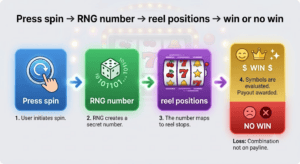
Diagram created using AI
Slot Machines Explained
Let’s look at the key components of a slot machine to get a better grasp on it.
Slot Machine Reels
When you start a slot machine game, you’ll see a grid of symbols arranged in vertical reels (columns) and horizontal rows. These reels are the vertical spinning parts of a slot machine game that spin to create specific symbol combinations that determine wins. Traditional slot machine screens featured three reels and three rows of symbols. As slot machine games became more popular, five- or even seven-reel games began to appear on the market.
Spin Cost and Bet Level – How Are They Related?
Spin cost and bet level are often confused, but they work together to determine your total stake per spin. Your total stake is the coin or line value multiplied by the number of active paylines. In the UK, online slot stakes are capped, so you won’t encounter the high-value spins seen elsewhere.
The bet level typically acts as a multiplier or sets the number of lines, directly influencing your spending and potential winnings. Understanding this can help to make sure that you bet exactly what you intend, avoiding unexpected costs or disappointing results.
Paylines
A payline is a line that runs through symbols to form a winning combination in a single spin of a slot machine. Different slot machine games have different amounts of paylines, ranging from one to one hundred. However, the most popular slots have 10 – 25 paylines. Often, players can decide how many paylines to activate.
The number of paylines affects not only the frequency and size of wins, but also the cost of each spin. It’s important to note that paylines aren’t always straight. You can find out which paylines a game offers before spinning or changing the number of paylines. Some modern slots use Megaways, which replace fixed paylines with dynamic patterns.
What Determines Wins in Slot Machine Games?
Slot symbols have different values based on their rarity. A win occurs when matching symbols land on an active payline. The outcome is determined instantly by the RNG when you spin. Rarer symbols pay more, while common ones pay less. Only the symbols on active paylines count toward a win.
Special Symbols and Features
- Multipliers multiply your winnings by a set factor such as 2x, 10x, etc., and they can appear in the main game or bonus round.
- Wild Symbols substitute for other symbols to complete winning combinations. They adapt to matching symbols on the payline, boosting your chances of a win.
- Scatter Symbols trigger wins, free spins, or bonus rounds regardless of paylines.
- Free Spins are triggered by scatter symbols, and they let you play without paying. These spins are usually worth the same amount as your original bet.
Types of Slot Machines
Different types of slots were created so players could enjoy diverse experiences while playing. Let’s look at them.
Classic 3-Reel Slots
They are like the traditional fruit machines and feature three reels with a limited number of paylines.
Video Slots
These games typically have five reels but can feature many more, and they offer multiple paylines.
Progressive Jackpot Slots
The jackpot increases as players bet, then resets after being won.
Megaways
These slots can change symbol counts per reel each spin, creating thousands of potential ways to win.
Are Slot Machines Random? Debunking Common Myths
UK-licensed games are tested by independent labs to ensure randomness and fairness. But there are often myths that surround slot machines. Let’s debunk them together:
X “A machine is due to pay out”: No, as each spin is independent and the RNG has no memory of past results.
X “Hot and cold machines”: No, as every spin is random, so machines don’t have cycles of winning and losing.
X “Time of day affects wins”: No, as RNG operates continuously and external factors don’t affect it.
X “Stopping the reels early changes the result”: No, as RNG determines the outcome immediately when you hit “Spin”, so reel control is irrelevant.
UK Rules for Online Slots
The UK Gambling Commission (UKGC) has established stake limits and designed rules for playing online slots. Here are all the important ones:
- Stakes have been limited to £5 per spin for players above 25, and £2 for 18–24-year-olds.
- Autoplay has been banned.
- There must be a 2.5-second minimum spin interval.
- Slots can’t celebrate a “win” equal to or smaller than the stake.
Note: 7bet is a UKGC-licensed casino. Play responsibly to enjoy the different options on our website.
Know More About Slot Machines (FAQs)
How Do Slot Machines Work?
Slot machines use a Random Number Generator (RNG) that instantly decides the result when you spin, and the reels show if you have won or not.
What Is a Slot Machine?
A slot machine is a popular, automated gaming device where players bet on random symbol combinations to win.
How Do Slots Work Online?
Online slots use the same RNG as physical machines, but you can play them from any device while maintaining fairness and randomness.
What Does RTP Mean in Slots?
Return to Player (RTP) is the percentage of money a slot machine pays back to players over a very long period.
Can You Predict When a Slot Will Pay Out?
No, you can’t predict when a slot will pay out. Slots are based on chance, as the RNG ensures the numbers are random and unpredictable, so there’s no way of knowing when it pays.
Betting is only available to participants above 18 years. Please bet responsibly. BeGambleAware.org