
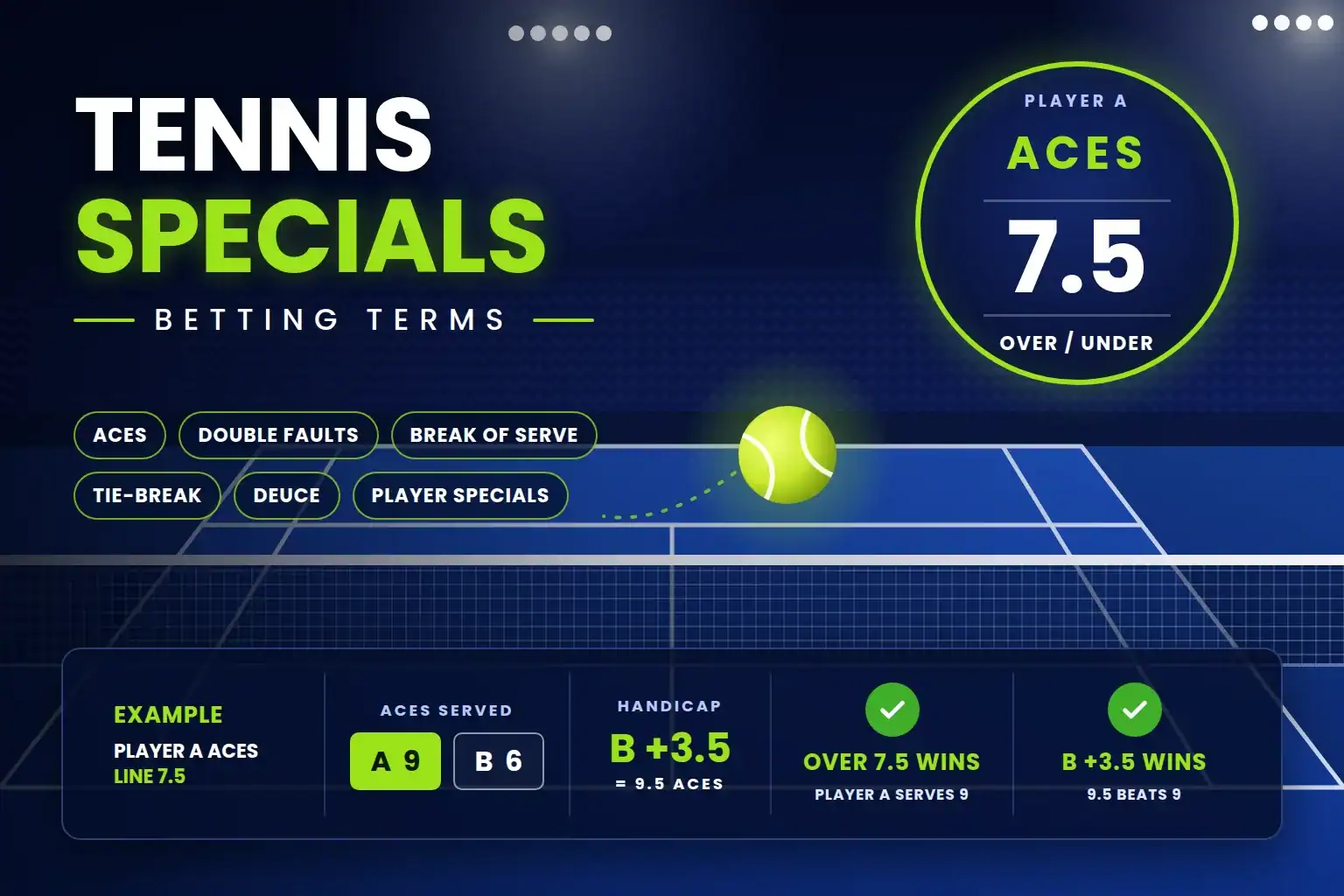


Tennis special markets let you bet on what happens inside a match rather than only on the final result. Aces, double faults, breaks of serve, tie-breaks and deuce games all have their own markets, often called player specials.
These markets suit bettors who follow serving and return statistics. A big server on grass, a player with an unreliable second serve, or two strong servers likely to meet in a tie-break can all point to a clear view, even when the match winner is hard to call.
This glossary explains the five main groups of tennis special markets, using the market names you will find at 7bet. To see which specials are available on upcoming matches, visit the 7bet tennis betting page.
Aces Betting
Aces betting covers markets based on the number of aces served in a match. An ace is a legal serve that the receiver does not touch.
The main markets are Total Aces (Over/Under) for both players combined and Player X Aces (Over/Under) for one player. Aces Matchbet asks which player will serve more aces, and Aces Handicap adds a handicap to one player’s ace count. Other options include Aces Milestones, Match Aces – At Least and Match First Ace. Many of these are also offered for a single set.
Ace counts are usually higher on fast courts such as grass, for tall or serve-led players, and in best-of-five matches.
Practical example: Player A’s line is Over/Under 7.5 aces. Player A serves 9 aces and Player B serves 6. Over 7.5 wins. In the Aces Matchbet, Player A wins with more aces. With an Aces Handicap of +3.5 for Player B, Player B’s total becomes 9.5, which beats Player A’s 9, so the Player B +3.5 selection wins.
Double Faults Betting
Double faults betting covers markets based on the number of double faults in a match. A double fault happens when a player misses both the first and second serve and loses the point.
The structure mirrors aces betting: Total Double Faults (Over/Under), Player X Double Faults (Over/Under), Double Faults Matchbet, Double Faults Handicap, Double Faults Milestones, Match Double Faults – At Least and Match First Double Fault. There is also a combined Aces & Double Faults (Over/Under) market.
Double faults tend to rise when a player serves aggressively on the second serve, is under pressure, or is struggling with form or injury.
Practical example: The line is Over/Under 5.5 total double faults. Player A commits 3 and Player B commits 4. The total is 7, so Over 5.5 wins.
Break Of Serve Betting
Break of serve betting covers markets based on how often a player wins a game on the opponent’s serve, known as a break.
The main markets are Total Breaks (Over/Under), Player X Total Breaks, Match First Break of Service and Most Breaks of Serve. The 2-way version asks which player will make more breaks. The 3-way version adds a third option: both players make the same number. Set-level markets such as Set N – xth break ask which player will make a specific break in a set.
Breaks are more common on slow courts such as clay and in matches between strong returners. Markets on whether a player holds a single service game are covered in our live tennis betting terms.
Practical example: You back Most Breaks of Serve (3-way) on “both players equal”. Player A breaks twice and Player B breaks twice. The bet wins. If Player A had broken three times, Player A would be the winning selection.
Tie-Break Betting
Tie-break betting covers markets based on whether a set reaches 6–6 and is decided by a tie-break, and who wins it.
The main markets are Will there be a tiebreak in the match, Will Set N Go To Tie Break, Total Tie Breaks and Tie Break Winner (Set X). Several of these are also offered live, with odds that shorten as a set gets closer to 6–6.
Tie-breaks are more likely between two strong servers, on fast courts and in matches between evenly matched players. For totals markets, remember that a tie-break counts as one game, as explained in our tennis totals betting terms.
Practical example: You back “Yes” in the Will there be a tiebreak market. Player A wins 7–6, 6–3. The first set was decided by a tie-break, so the bet wins.
Deuce Betting
Deuce betting is a market where you predict whether a specific game will reach deuce, the 40–40 score. Who goes on to win the game does not matter.
At 7bet the markets are Deuce in the game (Yes/No) and Will Game Go To Deuce? (Set N, Game X). Both are available pre-match and live.
Deuce is more likely when the server is under pressure or when both players are strong on return. Games served by big servers more often end before deuce.
Practical example: You back “Yes” on Set 1, Game 5 going to deuce. The game reaches 40–40 before Player B holds serve. The bet wins, because only reaching deuce counts, not who wins the game.
Understanding Tennis Special Markets
Tennis special markets turn serving and return statistics into bets. Aces and double faults depend on serve quality, breaks reflect return strength, and tie-break and deuce markets reward a view on how close a match or a game will be.
Settlement follows clear rules. If a player retires, markets that were already decided, such as an Over line already reached, are settled as normal, while undecided markets are void. Full details are in 7bet’s betting rules. You can browse special markets on current matches in the 7bet tennis section.
FAQ
What are player specials in tennis betting?
Player specials are markets based on match statistics rather than the final result, such as aces, double faults, breaks of serve and tie-breaks.
What happens to an aces bet if a player retires?
If the line was already passed before the retirement, an Over bet is settled as a win. If the result was not yet decided, the bet is void.
What does 3-way mean in Most Breaks of Serve?
The 3-way market adds a third option, where both players make the same number of breaks. The 2-way market only offers the two players.
Betting is only available to participants above 18 years. Please bet responsibly. BeGambleAware.org