
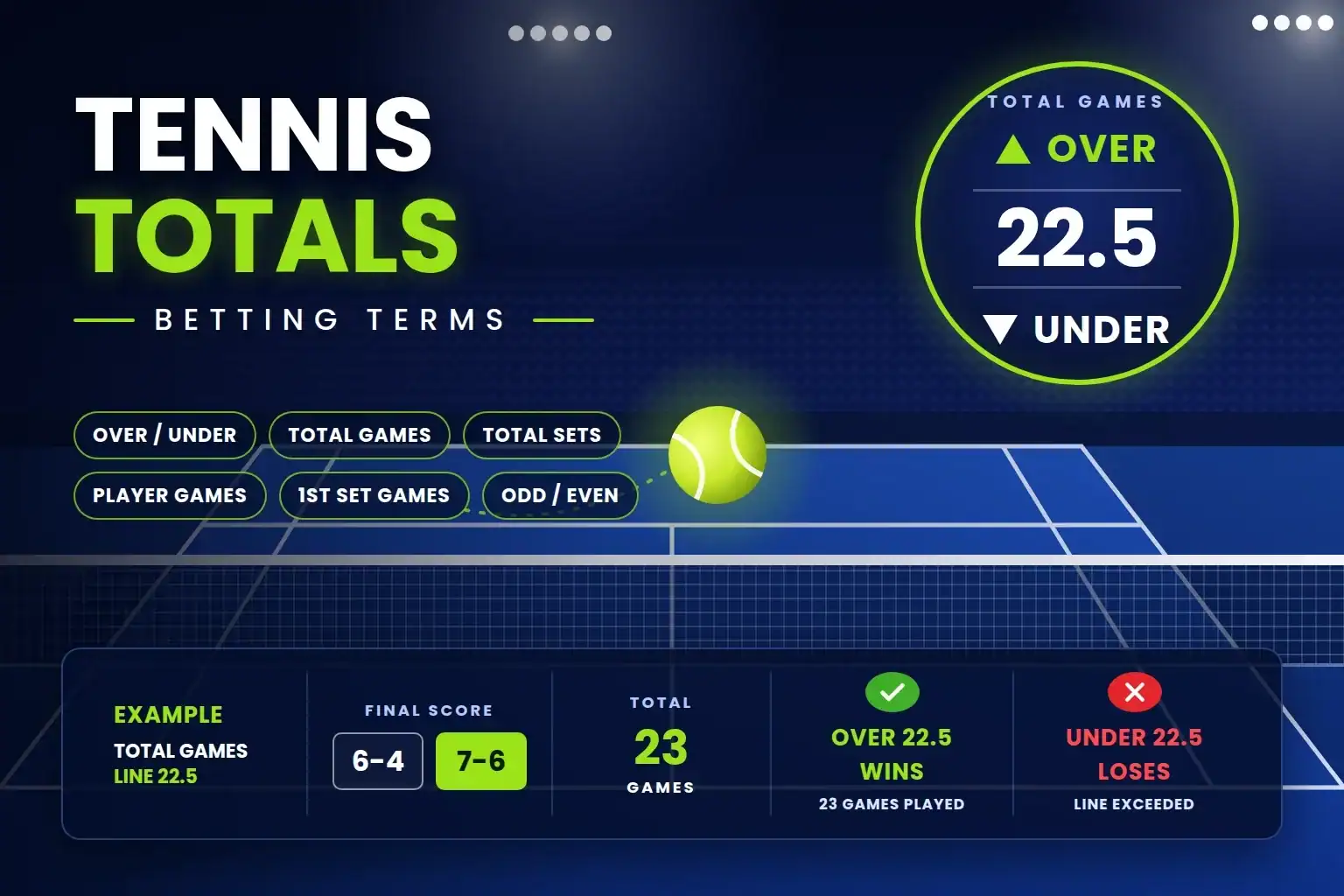


Totals betting in tennis is about how long a match runs, not who wins it. Instead of picking a player, you predict whether the number of games or sets will finish above or below a line set by the bookmaker.
This makes totals markets useful when two players look evenly matched, or when you expect a one-sided match but are unsure of the winner. Surface, serving strength and match format all shape how many games are played.
This glossary explains the six most common totals terms with simple tennis examples. When you are ready to see these markets on live fixtures, you can browse all tennis betting markets at 7bet.
Total Games Betting in Tennis
Total games betting is a market where you predict whether the combined number of games played by both players will be over or under a set line, such as 21.5 or 22.5.
Every game in every set counts, regardless of who wins it. A set that goes to a tie-break is usually counted as 7–6, so the tie-break itself adds one game to the total. Matches between two strong servers, especially on grass or fast hard courts, tend to produce higher totals because breaks of serve are rare.
Practical example: The total games line is 22.5. Player A wins 6–4, 7–6. The total is 6 + 4 + 7 + 6 = 23 games, so Over 22.5 wins and Under 22.5 loses.
Total games is different from game handicap betting. A handicap looks at the gap between the two players, while a total looks only at how many games are played in the match.
Total Sets Betting in Tennis
Total sets betting is a market where you predict whether a match will last more or fewer sets than the bookmaker’s line. The line depends on the match format.
In a best-of-three match, the usual line is 2.5 sets. Under 2.5 means the match ends 2–0, and Over 2.5 means it goes to a deciding third set. In best-of-five matches, such as men’s singles at Grand Slams, lines of 3.5 or 4.5 sets are common.
Practical example: The line is 2.5 sets. Player A wins 6–3, 4–6, 6–4. Three sets are played, so Over 2.5 wins.
The Under 2.5 outcome matches a straight-sets finish by either player. If you want to back one specific player to win without dropping a set, see Win in Straight Sets betting. The Over 2.5 outcome means both players win at least one set, which links to Player To Win At Least One Set betting. Total sets and set handicap betting also differ: one counts sets played, the other the margin between players.
Over/Under in Tennis Betting
Over/Under betting is the pair of selections used in every totals market. Over wins if the final count is higher than the line, and Under wins if it is lower.
The same principle applies to games, sets, a single player’s games or the first set only. Only the line and the thing being counted change.
Half-point and whole-number lines. Most tennis totals use a half-point line, such as 21.5, so the result can never land exactly on it. When the line is a whole number, such as 22, and exactly 22 games are played, the selection is usually settled as a push. In that case the stake is normally returned, but the exact rule depends on the bookmaker’s terms.
Practical example: The line is Over/Under 21.5 games. Player A wins 6–3, 6–4. The match has 19 games, so Under 21.5 wins and Over 21.5 loses.
Player Total Games Betting in Tennis
Player total games betting is a market where you predict whether one selected player will win more or fewer games than a line. The opponent’s games do not count.
This market is useful when you expect a player to be competitive but still lose. An underdog can go over their games line even in defeat, as long as they win enough games.
Practical example: Player B’s line is Over/Under 8.5 games. Player B loses 4–6, 6–7. Player B wins 4 + 6 = 10 games, so Over 8.5 wins even though Player B lost the match.
First Set Total Games Betting in Tennis
First set total games betting is a market where you predict whether the opening set will contain more or fewer games than a line, commonly 9.5. The rest of the match does not affect the result.
A completed set can contain between 6 games (6–0) and 13 games (7–6). This narrow range makes the tie-break decisive: a set that reaches 6–6 always goes over a 9.5 line.
Practical example: The line is Over/Under 9.5 games in the first set. Player A wins the first set 6–4. The set has 10 games, so Over 9.5 wins. If the set had finished 6–2, the 8 games would have made Under 9.5 the winning selection.
Odd/Even Total Games Betting in Tennis
Odd/Even total games betting is a market where you predict whether the total number of games in the match will be an odd or an even number. The size of the total does not matter.
A tie-break set such as 7–6 always adds 13 games, an odd number, which can change the result on its own. In deciding sets that use a match tie-break, bookmakers usually count the tie-break as one game, but this should be checked in the market rules.
Practical example: Player A wins 6–3, 6–4. The match has 19 games, so Odd wins and Even loses.
Understanding Tennis Totals Markets
All tennis totals markets work on one idea: a line is set, and the result is settled on whether the count finishes over or under it. What changes is what is being counted — games, sets, one player’s games, the first set, or whether the total is odd or even.
Before choosing a totals market, it helps to check the match format, the playing surface and how strong both players are on serve. These factors have the biggest influence on how many games and sets a match produces. You can compare totals lines on upcoming matches in the 7bet tennis betting section.
For related markets, see the Tennis Handicap Betting Terms glossary.
FAQ
Does a tie-break count as a game in total games betting?
Yes. A set won in a tie-break is usually recorded as 7–6, so the tie-break adds one game to the total.
What happens to a totals bet if a player retires?
Settlement depends on the bookmaker’s rules. Totals bets are often void if the match is not completed, unless the result was already decided before the retirement.
What is the difference between total games and game handicap?
Total games counts all games played by both players. A game handicap adjusts one player’s games to measure the margin between them.
Betting is only available to participants above 18 years. Please bet responsibly. BeGambleAware.org