
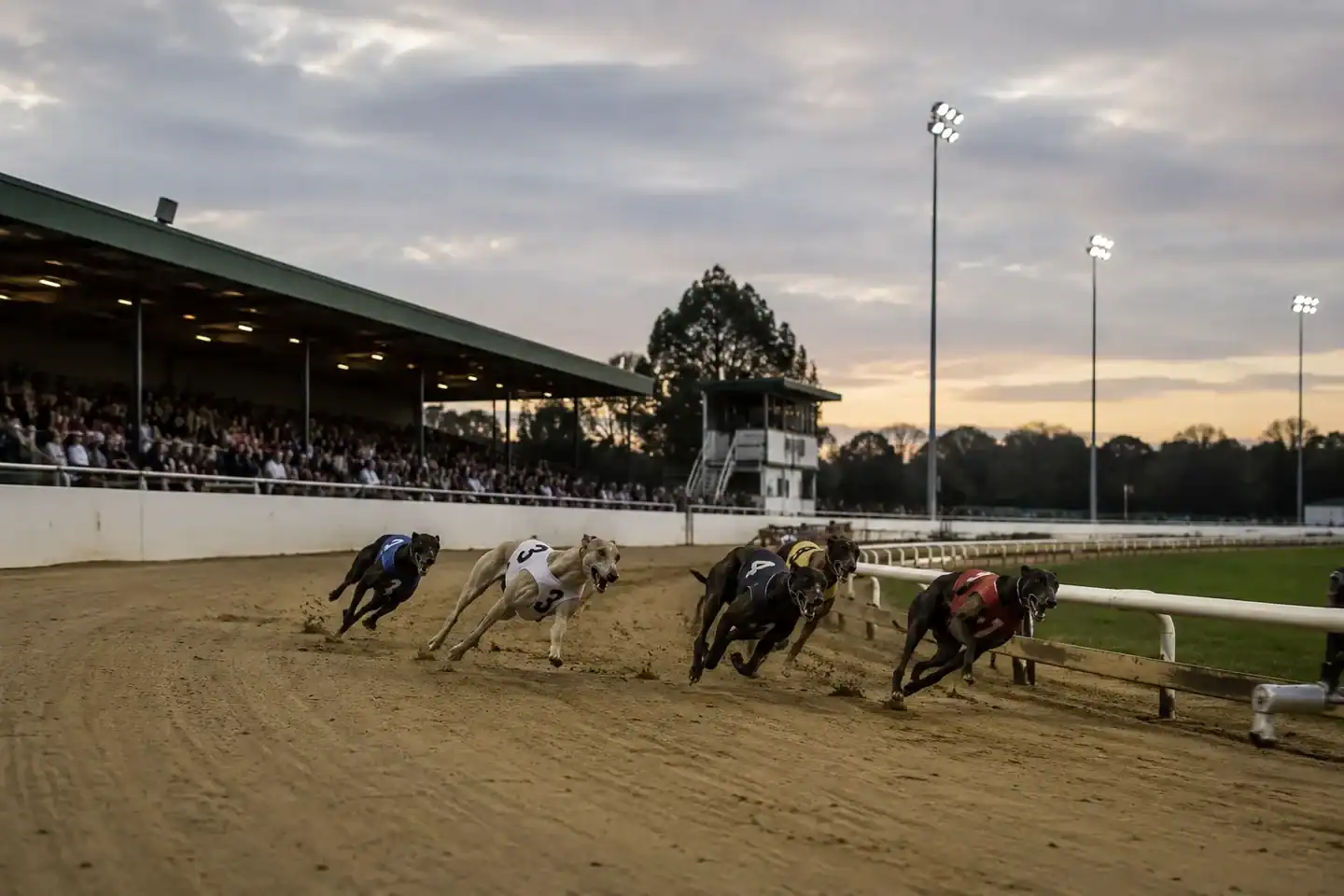


Greyhound racing has a simple structure. A small field of greyhounds covers a set distance around the track, and the order they finish in becomes the official result. A bet is a choice about that order in one particular race, with a stake attached to it.
This greyhound betting guide is for readers starting from zero when it comes to this type of competition. I’ll walk you through how to bet on greyhounds one step at a time – finding a race, understanding what you have to do, placing the bet, and knowing what happens to it once the race is over.
How Does Greyhound Betting Work?
Every greyhound race is a self-contained event. A field of greyhounds (usually six at British tracks) starts from numbered boxes called traps, runs a set distance, and finishes in an order that is recorded as the official result.
Betting on that race means answering a question about it. Which greyhound finishes first? Which two fill the first two places? Each question is a separate betting market, and each market holds the possible answers you can choose from. The most common of these markets asks which greyhound will win the race.
Once you pick an answer, the sportsbook shows a price beside it. That price is the odds, and it establishes what you get if your bet wins. Shorter odds return less than longer ones, and the price shown can change while betting is open.
The last decision is the stake, which is the amount of money you bet on a certain outcome. You enter it, check the details and confirm. From that point the bet is fixed.
The race then starts, officials record the finishing order, and the sportsbook settles the bet against that result and the rules for the market you chose.
How to Bet on Greyhounds Step by Step
The process below is the same at most sportsbooks, only the layout of the page will differ.
Step 1: Find a Greyhound Race
Greyhound racing takes place on most days of the week, and races are grouped into meetings. A meeting is the scheduled programme of races held at one track on one day.
On a sportsbook, greyhound racing usually has its own section, with the day’s meetings listed by track name. Open one and you will see its races in order, each with a scheduled start time.
Step 2: Look at the Runners
Opening a race shows you the greyhounds taking part. Each is listed with its name and its trap number, which is the numbered box it starts from.
The listing may also show extra detail depending on the sportsbook, like recent form, the trainer or previous times over the same distance. None of it is required in order to place a bet, it’s just there for readers who want to look at it.
Step 3: Choose the Type of Bet
Next comes the type of bet, and there are five you will see all the time.
- Win: the greyhound you choose has to finish first.
- Place: the greyhound has to finish in the first two.
- Each-way: one stake on the win and an equal stake on the place, so the bet costs double the unit amount.
- Forecast: a bet naming the first two finishers in the correct order.
- Tricast: a bet naming the first three finishers in the correct order.
Step 4: Select the Odds
Each selection has a price displayed next to it. Selecting that price normally adds the greyhound, and the bet type you have chosen, to your bet slip (the panel where a bet is assembled before it is confirmed).
Nothing has been staked at this point. The selection is just sitting there waiting for you to complete the next step.
Step 5: Enter the Stake and Review the Bet
The stake goes in on the bet slip. Once it is entered, the slip will normally show the potential return: what the bet would pay based on the odds attached to it.
Recheck all the details carefully before confirming – the race, the greyhound, the bet type, the odds and the stake. If everything matches what you intended, confirming places the bet. That is how to bet on greyhounds from start to finish.
A Simple Greyhound Bet Example
Let’s look at an invented example. It does not refer to a real meeting or a real greyhound.
A race at Track A has six runners, numbered trap 1 to trap 6. You decide to bet on the greyhound in trap 3, which is showing at 4/1.
Fractional odds work like this: the number on the left is the profit, the number on the right is the stake needed to earn it. So 4/1 is four pounds of profit for every pound staked.
You choose a win bet and enter a £2 stake. That is the full cost of the bet, because a win bet puts a single stake on a single outcome.
If the trap 3 greyhound finishes first, the profit is £2 × 4, which is £8. Your initial stake is returned on top of that, so the total return is £10.
If it finishes second, third or anywhere else, the win bet loses and the £2 stake is not returned. A win bet is settled on first place only, so how close the finish was makes no difference to the outcome.
What Information Should You Understand Before Placing a Greyhound Bet?
Trap Number
The trap number identifies the starting box a greyhound races from. British races use six traps, numbered 1 to 6, with trap 1 nearest the inside of the track and trap 6 on the outside.
Each trap has a fixed jacket colour so the runners can be told apart at speed: 1 red, 2 blue, 3 white, 4 black, 5 orange, and 6 black-and-white stripes. The number is an identifier and nothing more.
Race Distance
Greyhound races are run over a range of distances. Sprints cover about 200 to 300 metres, most graded racing sits somewhere between roughly 400 and 500 metres. Marathon races extend past 800 metres at some tracks.
The distance appears with the race details. It matters mainly because a greyhound’s past results were set over a particular distance, which may not be the one it is running today.
Recent Form
Form is a record of how a greyhound has finished in recent races, usually shown as a short string of finishing positions with the latest run at one end. A sportsbook may occasionally also have a comment describing a previous run.
All of it is historical. It describes races that have already been run and it does not indicate the result of the next one, so don’t rely on that.
Odds
The odds are the price attached to an outcome at that moment, shown either as a fraction, such as 4/1, or as a decimal, such as 5.00. The two formats mean the exact same thing, they’re just written differently.
The price tells you what a winning bet returns. It does not tell you what will happen. It’s also not a fixed number, as it can change until right before the race starts.
Greyhound Betting Terms Beginners Should Know
Trap: the numbered starting box a greyhound races from, numbered from the inside of the track outwards.
Runner: a greyhound taking part in a particular race.
Stake: the amount of money placed on a bet.
Odds: the price attached to a particular outcome, shown as a fraction or a decimal.
Favourite: the runner with the shortest odds in the market at that point. It describes the price, not the expected result.
Non-runner: a greyhound that has been withdrawn from the race and will not take part.
Forecast: a bet on which greyhounds fill the first two finishing positions.
Tricast: a bet on which greyhounds fill the first three finishing positions.
Dead heat: when two or more runners are officially judged to have finished level. In this case only part of your stake is treated as a winning bet: the stake is divided by the number of runners sharing that tie, and only that share is paid at the odds you took. The rest is lost. So if two runners finish level, including the one you bet would have won, half your stake wins and half does not.
Common Mistakes When Learning How Greyhound Betting Works
Assuming the Favourite Will Win
The favourite is the runner with the shortest odds at a given moment. That describes how the market has been priced according to the bookmakers, but there’s no guarantee the favourite will win. Favourites are beaten regularly in every form of racing, and a short price does not remove that possibility.
Confusing Trap Number With Finishing Position
Trap 1 is not a prediction that the greyhound will finish first, and trap 6 is not a prediction that it will finish last. The number refers only to the starting box. Finishing positions are decided by the race itself and recorded separately in the official result.
Treating Previous Results as a Guarantee
Recent form describes what has already happened, and nothing beyond that. Two greyhounds with identical form lines can finish in either order today. Past results cannot settle the next race in advance.
Not Checking the Type of Bet
A win bet, an each-way bet, a forecast and a tricast all have different settlement requirements, and it is easy to confirm one when you meant another. A forecast needs two greyhounds in the right order. A win bet needs one in first place. Always recheck your bets to make sure you’ve chosen the one you wanted.
Ignoring Changes Before the Race
Greyhound betting odds can always change right up until the race starts. A greyhound can be withdrawn and become a non-runner, and the odds on the remaining runners can move in the meantime.
What Happens After You Place a Greyhound Bet?
Once the bet is confirmed, nothing further is required from you. The race happens and and officials record the order in which the runners crossed the line. That order becomes the official result.
The sportsbook then settles your bet against that result and the rules of the market chosen. A winning return is credited to the account. A losing stake is not returned.
Some races do not finish cleanly. A greyhound may be withdrawn before the start and become a non-runner. Two runners may be judged to have finished level, which is a dead heat. A meeting may be abandoned before a race takes place at all. Settlement in those cases follows a separate set of rules.
Each of those situations is covered by the sportsbook’s published betting rules, which explain how bets are treated in each case.
FAQ
How do you bet on greyhounds for the first time?
Choose a race from the day’s meetings, look at the runners and their trap numbers, then pick a bet type. A win bet is the most direct of them, settled on first place alone. Select the odds beside your choice, enter a stake on the bet slip, recheck the details and confirm.
What does a greyhound’s trap number mean?
It identifies the starting box the greyhound races from. British tracks use traps 1 to 6, with trap 1 nearest the inside of the track. It does not indicate where the greyhound is expected to finish.
What is a win bet in greyhound racing?
It’s a bet on which greyhound will finish first. If your bet wins, the payout is based on the odds attached to the result you’ve chosen. If the greyhound finishes anywhere else, the bet loses.
What is the difference between a forecast and a tricast?
A forecast is the bet that decides the first two finishing positions. A tricast covers the first three. Both normally require the greyhounds to be named in the correct finishing order.
Do greyhound odds change before the race?
Yes. Prices can move at any point while betting is open, and more than once. The odds applied to a bet are generally the ones shown when it was confirmed, although some bets are settled at the price at the start of the race instead. The sportsbook’s rules explain which.
What happens if the greyhound I selected is withdrawn?
That greyhound becomes a non-runner. How the bet is then treated depends on the market and on the sportsbook’s betting rules, and a withdrawal can also affect bets already placed on other runners in the same race.
Betting is only available to participants above 18 years. Please bet responsibly. BeGambleAware.org