


As of August 2026 there are 18 licensed greyhound tracks in the UK. Fifteen are in England, two are in Northern Ireland, and one is in Wales. Scotland has none.
Ask how many greyhound tracks in the UK are still running and you’ll get a different answer depending on where you look. Some of that is just out of date, as two tracks stopped racing in April 2026 and several widely read sources haven’t caught up.
Some include only the tracks licensed by the British regulator, which doesn’t cover Northern Ireland, and older totals often include the independent venues (they no longer exist).
This page lists every track still operating, where each one is and the reason behind the decline in number.
How Many Greyhound Tracks Are There in the UK?
There are 18 licensed greyhound tracks in the UK as of August 2026. Fifteen are in England, two in Northern Ireland, and one is in Wales.
Anyone asking how many greyhound tracks in the UK are still active should know that this total counts every venue currently staging racing, not only those licensed by one particular body.
That is where most of the confusion starts. 16 of the 18 are licensed by the Greyhound Board of Great Britain, which regulates the sport in England, Scotland and Wales. The two Northern Irish venues are overseen by Greyhound Racing Ireland instead, because the sport there is regulated on an all-Ireland basis. Sources that count GBGB licences alone therefore arrive at 16.
There is no separate category for unlicensed venues. Independent tracks, once numerous, no longer operate anywhere in Britain, so all 18 tracks are under a recognised regulator. Anything higher than 18 almost certainly includes tracks that have already closed.
Note: the GBGB’s own website also gives a figure of 18. That’s 18 licensed tracks, counted before two of them dropped racing in April 2026.
Current Greyhound Tracks in the UK
The table below lists every licensed venue currently staging greyhound racing, correct as of August 2026.
| Greyhound Track | Location | Country/Region | Status |
| Brighton & Hove Stadium | Hove, East Sussex | England (South East) | Active |
| Central Park Stadium | Sittingbourne, Kent | England (South East) | Active |
| Doncaster Stadium | Stainforth, South Yorkshire | England (Yorkshire) | Active |
| Dunstall Park | Wolverhampton, West Midlands | England (Midlands) | Active |
| Harlow Stadium | Harlow, Essex | England (East) | Active |
| Kinsley Stadium | Kinsley, West Yorkshire | England (Yorkshire) | Active |
| Monmore Green | Wolverhampton, West Midlands | England (Midlands) | Active |
| Newcastle Stadium (Brough Park) | Newcastle upon Tyne | England (North East) | Active |
| Nottingham Stadium (Colwick Park) | Nottingham | England (Midlands) | Active |
| Owlerton Stadium | Sheffield, South Yorkshire | England (Yorkshire) | Active |
| Pelaw Grange | Chester-le-Street, County Durham | England (North East) | Active |
| Romford Stadium | Romford, Greater London | England (London) | Active |
| Sunderland Stadium | Sunderland, Tyne and Wear | England (North East) | Active |
| Towcester Stadium | Towcester, Northamptonshire | England (Midlands) | Active |
| Yarmouth Stadium | Great Yarmouth, Norfolk | England (East) | Active |
| Valley Stadium | Ystrad Mynach, Caerphilly | Wales | Active (closure required by 2030) |
| Derry Greyhound Stadium (Brandywell) | Brandywell, Derry | Northern Ireland | Active |
| Drumbo Park (New Grosvenor Stadium) | Ballyskeagh, near Lisburn | Northern Ireland | Active |
The greyhound tracks in UK racing today are clustered in specific regions. The largest concentration is in the north of England, across Yorkshire and the North East. The Midlands accounts for four, including two in Wolverhampton alone, since Dunstall Park joined Monmore Green in the same city.
Five more English tracks are in London, the South East and East Anglia, and Wales has one. Northern Ireland’s two venues sit at opposite ends of the country, one in Derry and one at Ballyskeagh near Lisburn.
Some regions have nothing at all. There is no track in the South West, and none anywhere in the North West, despite Manchester being where the sport began in 1926. Greater London, which supported more than a dozen venues in the 1930s, is down to Romford.
Race schedules differ from venue to venue. Some tracks race five times a week, in the afternoon and evening. Others run two or three meetings and concentrate on weekends. The Northern Irish venues keep a lighter programme, with Derry racing on Monday evenings.
Individual fixtures also move around, particularly since broadcasters revised their coverage in 2026. This list reflects the position in August 2026. Greyhound tracks have closed at a steady rate for decades, and one of the 18, Valley Stadium in Wales, already has a legal end date.
Where Are the UK’s Greyhound Tracks Located?
The 18 venues split 15 to England, one to Wales, two to Northern Ireland and none to Scotland. The Northern Irish pair are Derry Greyhound Stadium at the Brandywell and Drumbo Park at Ballyskeagh near Lisburn, both licensed by Greyhound Racing Ireland. The three sections below cover the Great Britain nations.
Greyhound Tracks in England
15 of the 18 tracks are in England. Yorkshire and the North East hold the largest share between them, with Doncaster, Kinsley and Owlerton in Yorkshire, and Newcastle, Pelaw Grange and Sunderland in the North East. The Midlands has four: Monmore Green and Dunstall Park in Wolverhampton, Nottingham at Colwick Park, and Towcester in Northamptonshire.
The south and east account for the rest, with Romford the only track left in London, Central Park in Kent, Harlow in Essex, Yarmouth on the Norfolk coast and Brighton & Hove in Sussex. Owlerton has staged greyhound racing since 1932, and Romford was named the GBGB’s first Track of the Year in 2026.
Greyhound Tracks in Scotland
Scotland has no active greyhound tracks. Its last venue, Thornton Stadium in Fife, suspended racing indefinitely in 2025 and has not reopened. In March 2026 the Scottish Parliament passed legislation making it illegal to operate a greyhound racing track in Scotland, so it won’t reopen.
Greyhound Tracks in Wales
Wales has one licensed track, Valley Stadium at Ystrad Mynach in Caerphilly, and it is still racing. Its future is fixed, however. The Prohibition of Greyhound Racing (Wales) Act 2026 received Royal Assent in April 2026 and requires the sport to end in Wales at some point between 2027 and 2030. When that happens, every remaining licensed track in Great Britain will be in England.
Major Greyhound Tracks in the UK
A small number of venues carry a disproportionate share of the sport’s major competitions and its regular race meetings. The four profiled below are among the most prominent currently operating. I’ve chosen these four to reflect different parts of the country (so it’s not a ranking), and all four are licensed by the GBGB.
Towcester Racecourse
Towcester, in Northamptonshire, is the current home of the English Greyhound Derby, the sport’s oldest and best-known competition. The Derby runs over six rounds, attracts around 180 entries and carries a winner’s prize of £175,000, making it comfortably the largest event in the British calendar. Greyhound racing was added to the existing horse racing course in 2014 and returned in 2020 after a break.
Romford Greyhound Stadium
Romford is in the London Borough of Havering and is the last greyhound track operating in Greater London, following the closure of Crayford in 2025. It races frequently, including regular afternoon meetings. In 2026 it was named the first winner of the GBGB’s Track of the Year award, introduced as part of the sport’s centenary and decided partly on feedback from race-goers.
Sheffield Greyhound Stadium
Owlerton Stadium, usually referred to simply as Sheffield, has staged greyhound racing since 1932 and now races five times a week. It holds around 4,000 spectators and shares the site with speedway and stock car racing. Its best-known fixture is the Steel City Cup, a Category One competition first run in 1970 over 500 metres.
Monmore Green
Monmore Green is one of two licensed tracks in Wolverhampton and a regular fixture on the afternoon betting shop schedule. It hosts the Monmore Puppy Derby, one of several competitions restricted to younger greyhounds. Since Dunstall Park opened at the city’s horse racing course, Wolverhampton has become the only city in Britain with two licensed greyhound tracks.
Why Do Different Sources Give Different Numbers of UK Greyhound Tracks?
Published totals for UK greyhound tracks range from 16 to 20, and there are five common reasons for the gap.
- The date. Two tracks, Oxford and Suffolk Downs, stopped racing in April 2026. Any article written before then will give a higher figure, and a number of sources that carry a 2026 date have not been revised since.
- Whether Northern Ireland is counted. Its two venues are UK tracks, but they fall outside the GBGB’s jurisdiction, so any figure built from GBGB licences alone comes up two short.
- Licensed and independent venues were historically counted separately, which inflated older totals considerably.
- Closed tracks. Poole, for example, still has a working website with race times on it, but its greyhound racing ended permanently in 2020. Several lists still include it.
- Regulators and journalists sometimes count licences rather than active venues. The two figures diverge whenever a track holds a licence but is not staging meetings.
Licensed vs Independent Greyhound Tracks
A licensed greyhound track is one that races under a recognised regulator’s rules. In England, Scotland and Wales that regulator is the Greyhound Board of Great Britain, whose Rules of Racing cover the track, trainers and kennel staff, veterinary provision on race days, drug testing, and the registration and retirement of every greyhound that runs.
The GBGB has been accredited by the United Kingdom Accreditation Service since 2010. In Northern Ireland the equivalent body is Greyhound Racing Ireland, because the sport there is regulated on an all-Ireland basis.
An independent track, known in the sport as a flapping track, operated without any such registration. There was no governing body, so welfare and integrity standards were set locally. Independent tracks were once numerous, and in the 1940s there were more than 200 of them alongside the licensed venues.
Why did I say “operated”? Because independent tracks no longer exist. The last independent track in Britain closed in 2025, so all 18 operating UK venues now race under a regulator. This is why the headline figure on this page is the same whether you count licensed tracks only or every operating venue.
The distinction still matters when reading older sources, because totals from the mid-20th century usually combine both types and are therefore far larger than anything published today.
How Has the Number of Greyhound Tracks in the UK Changed?
Greyhound racing in Britain began at Belle Vue in Manchester on 24 July 1926 and expanded quickly, with tracks opening in almost every major British city within a few years.
By the late 1940s there were 77 licensed tracks in the UK, 33 of them in London, together with more than 200 independent venues. Attendance figures from the period were substantial: totalisator turnover in 1946 alone reached £196 million, and more than 50,000 people attended the opening rounds of that year’s Derby.
The decline began in the early 1960s. The Betting and Gaming Act 1960 allowed off-course cash betting for the first time, which removed one of the main reasons to attend a meeting in person. 21 licensed tracks closed between 1961 and 1969, and 91 closed in total between 1960 and 2010.
Other factors have driven closures since then:
- Stadium sites in urban areas became more valuable as development land than as racing venues, and a number of tracks were sold for housing.
- Attendances fell as other leisure options multiplied.
- Running costs rose while income did not keep pace, and in 2026 changes to broadcast contracts removed the coverage that some venues depended on. Two tracks stopped racing within weeks of that decision.
The most recent change is its legal status. Wales and Scotland both passed laws banning greyhound racing in March 2026, which fixes the maximum number of tracks in those two nations at zero. The legislation applies only to Wales and Scotland, so the venues in England and Northern Ireland are unaffected by it.
Famous UK Greyhound Tracks That Have Closed
The venues below are among the best known of the many that have closed.
White City, London – closed 1984. For most of the 20th century White City was the sport’s principal venue, hosting the English Greyhound Derby from 1927 until it closed, with a record 92,000 spectators at the 1939 final.
Harringay, London – closed 1987. The third greyhound stadium to open in Britain, Harringay ran for 50 years and housed one of the sport’s earliest mechanical totalisators.
Walthamstow, London – closed 2008. Widely regarded as Britain’s leading greyhound stadium after White City shut, Walthamstow’s art deco entrance and tote board were given listed status in 2007, the year before racing ended.
Belle Vue, Manchester – closed 2020. The birthplace of British greyhound racing, Belle Vue staged the country’s first oval meeting in July 1926 and closed after 94 years of racing.
Wimbledon, London – closed 2017. Wimbledon hosted the English Greyhound Derby for several decades after White City shut and was the last greyhound stadium in south west London. The site has since been redeveloped.
Crayford, London – closed 2025. Crayford’s closure left Romford as the only greyhound track still operating anywhere in the capital, a city that once had more than 30.
What Is a UK Greyhound Track Like?
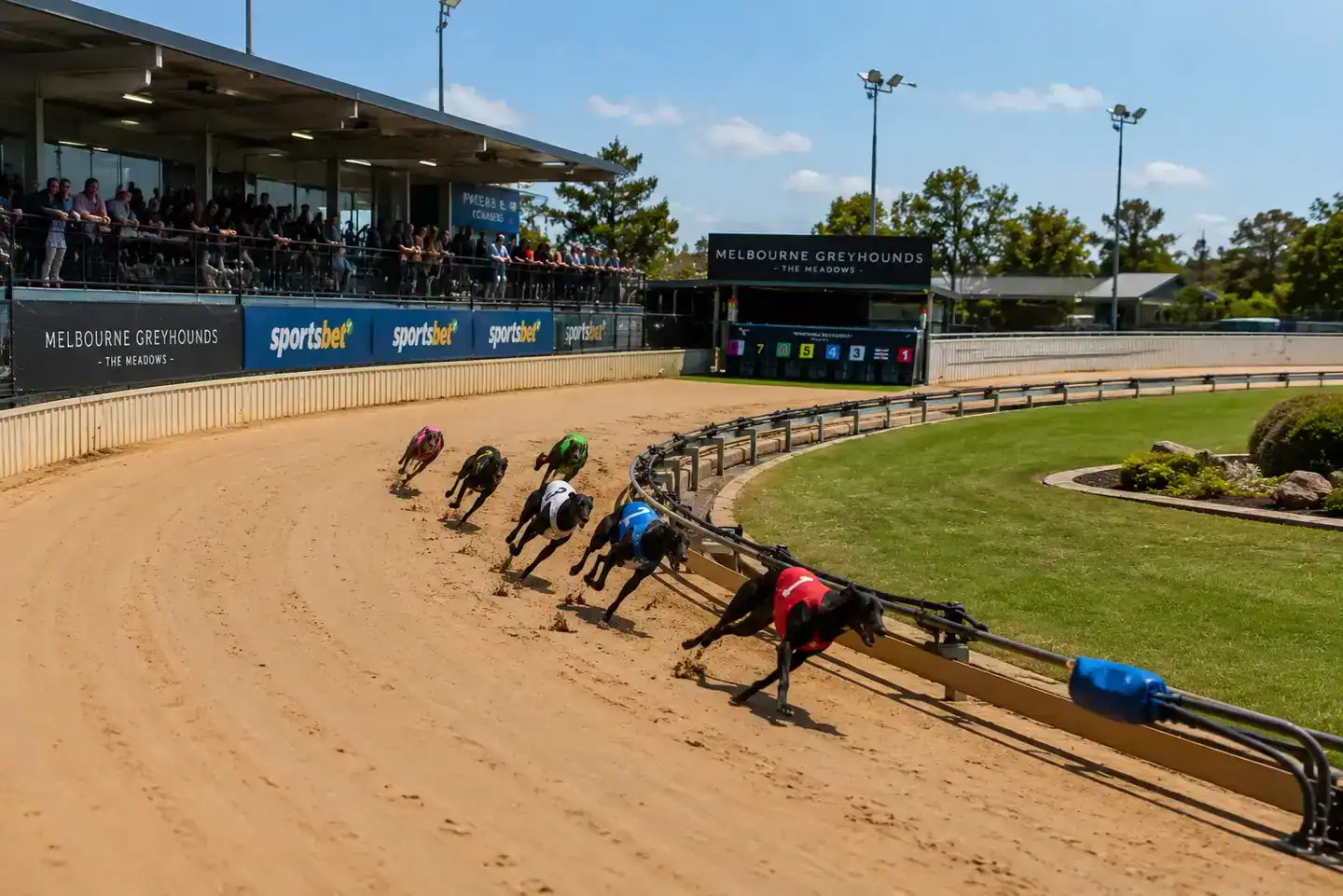
A licensed greyhound track is an oval circuit with a sand running surface, raced anticlockwise.
Greyhounds start from mechanical starting traps positioned at the top of the straight and chase an artificial hare mounted on a rail, which runs ahead of the field and is stopped once the race is over. Three hare systems are in general use, and which one a track has affects whether the lure runs on the inside or the outside of the circuit.
Races are contested by six greyhounds, each wearing a numbered jacket in a set colour so that dogs can be identified even when they’re running. Trap 1 is red, trap 2 blue, trap 3 white, trap 4 black, trap 5 orange and trap 6 black and white stripes. Races with eight dogs are not held anymore in the UK.
Finishes are recorded by photo-finish and electronic timing, which also produces the sectional and overall times that appear in the form book. Every licensed track must have veterinary facilities on site, and a vet checks each greyhound before it is allowed to race.
Spectator facilities vary widely. Some have open terracing. Others even have glass-fronted restaurants overlooking the track.
Are All Greyhound Tracks the Same Size?
No. Circuit sizes vary considerably from track to track, and so does the run from the traps to the first bend, which is one of the main things that makes each venue race differently.
Distances vary too. Most offer a standard trip plus a sprint and a staying distance, and some add a marathon distance, but the exact metres differ everywhere. There is no single standard track size or race distance used across British greyhound racing.
FAQ
How many greyhound tracks are in the UK?
There are 18 greyhound tracks operating in the UK as of August 2026: 15 in England, one in Wales and two in Northern Ireland. Scotland has none. 16 are licensed by the Greyhound Board of Great Britain and two by Greyhound Racing Ireland.
Why do some websites show a different number of UK greyhound tracks?
Usually because of the date. Two tracks stopped racing in April 2026, and many pages have not been updated since. Lower figures often count GBGB licences alone, which leaves out Northern Ireland. Others differ on whether to count licences or active venues.
How many greyhound tracks are in England?
15, as of August 2026, spread across Yorkshire, the North East, the Midlands, London, the South East and East Anglia. There is no track in the South West or the North West.
Are there greyhound tracks in Scotland?
No. Thornton Stadium in Fife, the last Scottish venue, suspended racing in 2025, and legislation passed in March 2026 makes operating a track there illegal.
Are there greyhound tracks in Wales?
Yes, there’s one. Valley Stadium at Ystrad Mynach is still racing, but the Prohibition of Greyhound Racing (Wales) Act 2026 requires greyhound racing in Wales to end between April 2027 and April 2030.
Are there any greyhound tracks in London?
Yes, one. Romford Stadium in Havering is the last active track in the capital, after Crayford closed in 2025. London once had more than 30, including White City, Harringay, Walthamstow and Wimbledon.
Which is the most famous greyhound track in the UK?
This depends on how fame is measured. Among tracks still operating, Towcester has the strongest claim, as it stages the English Derby. Historically, White City is the better-known name, having hosted the Derby for over 50 years.
Betting is only available to participants above 18 years. Please bet responsibly. BeGambleAware.org