
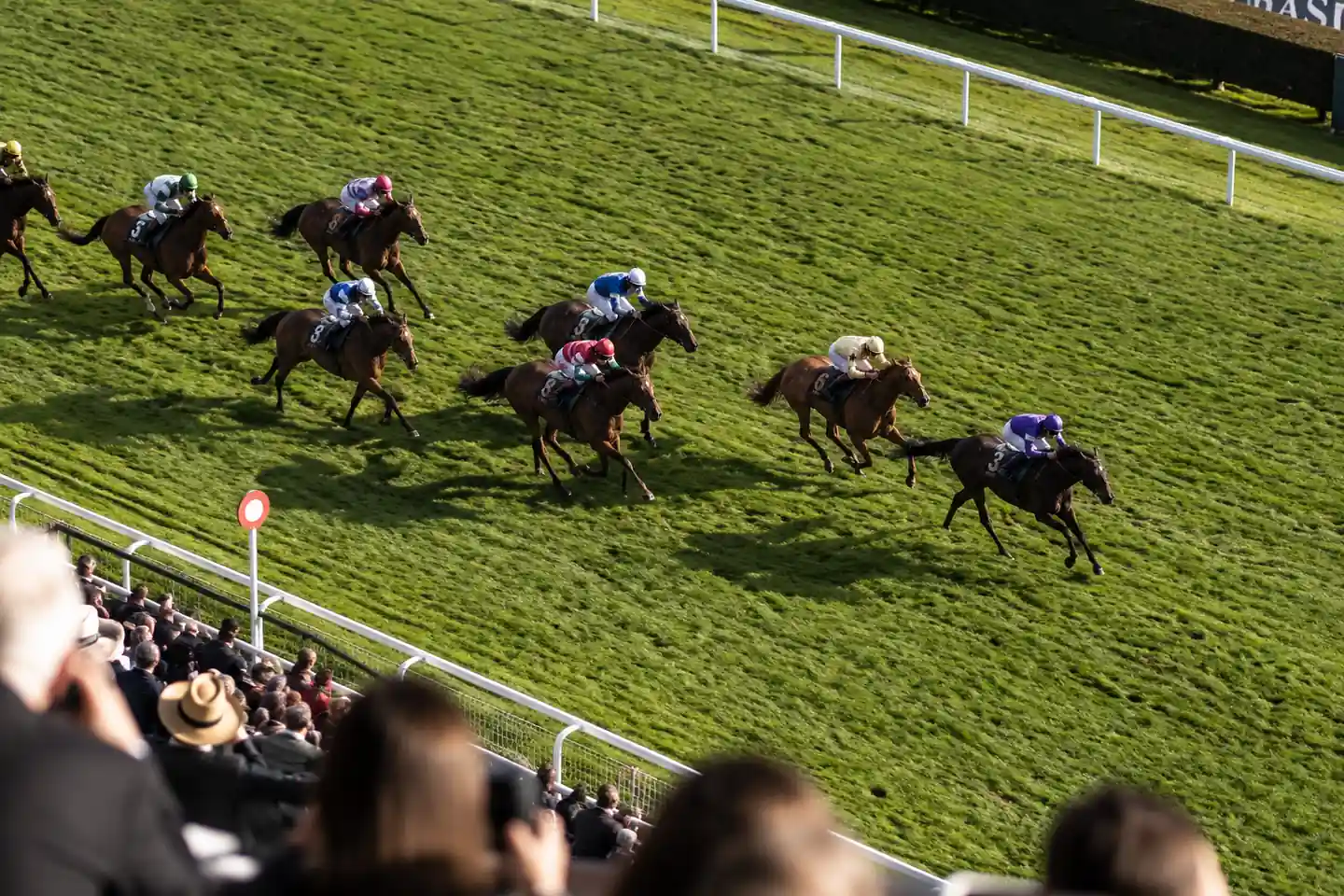


For new fans of the sport, understanding the various race classifications can be somewhat confusing. One term that often comes up is: What is a bumper in horse racing? A bumper race is a National Hunt Flat race that’s run without hurdles or fences. They give less experienced jumps-bred horses the chance to experience a controlled introduction to racecourse conditions, before they progress to hurdling or chasing. While they’re associated with National Hunt racing, the horses race on the Flat.
The British Horseracing Authority describes National Hunt Flat races as “also known as Bumpers”. It states that they’re designed to give those late-maturing, jumps-bred horses more experience before hurdles or fences.
What Is a Bumper Race?
The official term for a bumper is a National Hunt Flat race, commonly shortened to “bumper” in racing circles. Although they are part of the National Hunt (jumps racing) programme, a bumper race is contested without any obstacles on the track. Its primary function is educational: to introduce relatively inexperienced horses to the unique pressures of racecourse competition.
Running in a bumper allows young horses to gain vital experience of travelling in a large field alongside other runners. They learn to cope with the pace of a race, navigate around a National Hunt course, which often features undulations and different turf conditions, and become accustomed to responding to a jockey’s commands under competitive conditions. It’s a stepping stone before they progress to novice hurdles and eventually to steeplechasing.
Not every horse appearing in a bumper race will develop into a high-level jumper. Some may not take to jumping, while others may use the experience to find their feet in a racing environment. A bumper should not be viewed simply as a standard Flat race; its specific eligibility rules and its defined role within the National Hunt pathway make it a distinct discipline. The Racing Post similarly describes bumpers as Flat races under National Hunt rules intended to introduce inexperienced horses to racing before they are required to jump obstacles.
Why Is It Called a Bumper in Horse Racing?
“Bumper” is the traditional informal name given to a bumper race, i.e. a National Hunt Flat race, and the term is deeply embedded in the vocabulary of British and Irish racing fans. While the nickname is universally understood, official racecards typically list these events as a “National Hunt Flat Race” or use the abbreviation “NHF”. For instance, the Racing Post uses NHF to designate National Hunt Flat races in its racecards and form guides.
The precise origin of the nickname isn’t firmly established, so it’s best treated as informal tradition rather than confirmed fact. Regardless of its etymology, the term “bumper” remains common parlance among racing enthusiasts, even when official descriptions use the longer formal title. You might see a racecard list an event simply as a “National Hunt Flat Race”, “NHF”, or “Bumper”, with all three referring to the same type of contest.
How Are Bumpers Different From Other Horse Races?
Distinguishing between the major race types is essential. Bumpers occupy a unique space in the racing calendar, and they are fundamentally different from other disciplines.
Bumper vs Flat Race
A bumper and a standard Flat race look similar because neither includes hurdles or fences. They operate within different racing disciplines. A bumper race is for horses being developed for a future career in jumps racing. Standard Flat racing has its own distinct race programme, horse types (often bred specifically for speed over shorter or longer distances), and a career progression that doesn’t lead to hurdling or chasing.
Bumper vs Hurdle Race
This distinction is more straightforward. A hurdle race requires horses to jump over a series of timber obstacles (hurdles) set at specific intervals along the track. A bumper race, by definition, has no obstacles whatsoever. In the progression of a National Hunt horse, it is common for horses to run in bumpers before a hurdling career.
Bumper vs Chase
A steeplechase (or chase) is run over much larger and more substantial fences than hurdles. Chases are generally contested by more experienced, older horses. Bumpers, on the other hand, are designed for the very earliest stage of a National Hunt horse’s career, long before they would be considered ready for a chase.
| Race type | Obstacles? | Racing discipline |
| Bumper / NH Flat | No | National Hunt |
| Flat race | No | Flat racing |
| Hurdle | Hurdles | National Hunt |
| Chase | Fences | National Hunt |
As the Racing Post distinguishes, National Hunt racing is separate from ordinary Flat racing, and bumpers are the specific form of National Hunt racing in which horses race without obstacles.
What Are the Rules for Bumper Races?
The rules for bumper races in the UK are governed by the British Horseracing Authority (BHA) and focus on maintaining the educational intent of the race type. These National Hunt Flat rules are designed to protect inexperienced horses in bumper races from being overmatched. British bumpers are designed around inexperienced National Hunt horses, and the rules reflect this. Under current BHA rules, horses competing must be seven years old or younger. Individual races may impose narrower age restrictions, so it’s necessary to check the racecards. Horses cannot have previously competed in another type of race. Previous participation in other bumpers, and in certain point-to-points, can be permitted depending on the conditions of the race in question.
Some bumper race rules include further restrictions. Races may be limited by:
- Age (e.g., open to four to six-year-olds only).
- Sex (fillies’ or mares’ only races).
- Previous wins (e.g., maiden races for horses that haven’t won).
- Jockey category (e.g., amateur riders or conditional jockeys).
Distances and ground conditions can also differ significantly between individual bumpers, which are often run over varying trips. In Britain, National Hunt Flat races must be run over at least one and a half miles and no more than two and a quarter miles, although individual race conditions vary. It’s important to review the race conditions on the specific racecard rather than assuming every National Hunt Flat race follows identical entry conditions. Point-to-point eligibility has specific caveats, and not every point-to-point horse is automatically eligible for every bumper.
Major Bumper Races in the UK and Ireland
While bumpers are held throughout the National Hunt season, a few specific events tend to attract wider attention.
Champion Bumper
The Champion Bumper at the Cheltenham Festival is one of the best-known National Hunt Flat races in the calendar. It brings together a competitive field of promising young National Hunt horses from Britain and Ireland. Performances in the Champion Bumper can mark a horse as a notable prospect for future hurdle campaigns. It’s important to recognise that success in this Cheltenham bumper doesn’t guarantee later success over obstacles, as the transition to jumping is a different skill.
Other Bumpers
Bumper races also appear throughout the National Hunt season at British and Irish racecourses. These events range from ordinary maiden and standard races to higher-profile affairs with valuable prize money. Conditions and entry requirements for these National Hunt bumper races vary depending on the venue and the race programme. Major National Hunt venues frequently stage bumpers alongside their hurdle and chase cards, providing racecourse experience for young horses at non-festival meetings.
Frequently Asked Questions About Bumper Races
Do horses jump in a bumper race?
No. A bumper race is run without hurdles or fences, so the horses don’t jump at all.
Is a bumper a Flat race?
It’s a National Hunt Flat race, rather than a standard race within the Flat racing programme. The terminology reflects its place in the jumps racing structure.
Why do horses run in bumpers?
They give inexperienced National Hunt horses racing experience before moving on to hurdles or fences.
What does NHF mean in horse racing?
NHF stands for National Hunt Flat, the official designation for a bumper race on racecards.
Can a bumper horse go hurdling afterwards?
Yes. Many bumper horses are being prepared for future careers over hurdles, although individual career paths vary.
Betting is only available to participants above 18 years. Please bet responsibly. BeGambleAware.org