


An NBA court is 94 feet long and 50 feet wide, and it still feels crowded with ten (usually big) players on it. Basketball positions are how a team divides up that space. Each of the five positions comes with its own job, its own part of the court and its own set of skills.
In this guide I cover all five positions in basketball, what each player is responsible for and how positioning works in attack and in defence.
How Many Players Are on a Basketball Team?
Five per team on the court at any one time. An NBA squad has 15 players and a coach will usually use nine or ten of them in a game, but only five are allowed on the floor.
Those five are the point guard, shooting guard, small forward, power forward and centre. Substitutions are unlimited, so line-ups change all the time while the five positions stay the same.
Basketball Positions by Number (1–5)
Every position also has a number and knowing them makes a lot of basketball commentary easier to follow.
| Number | Position |
| 1 | Point Guard (PG) |
| 2 | Shooting Guard (SG) |
| 3 | Small Forward (SF) |
| 4 | Power Forward (PF) |
| 5 | Centre (C) |
Coaches use these numbers because plays are drawn up for spots on the floor, not for particular players. If a play tells the 2 to run to the corner, it works no matter who is playing there that night.
Commentators picked up the same habit, so a player described as a natural 3 is a small forward, and someone “playing the 4” has been moved into the power forward’s job for a while. It’s also the quickest way to describe a player who covers more than one role.
The Five Basketball Positions
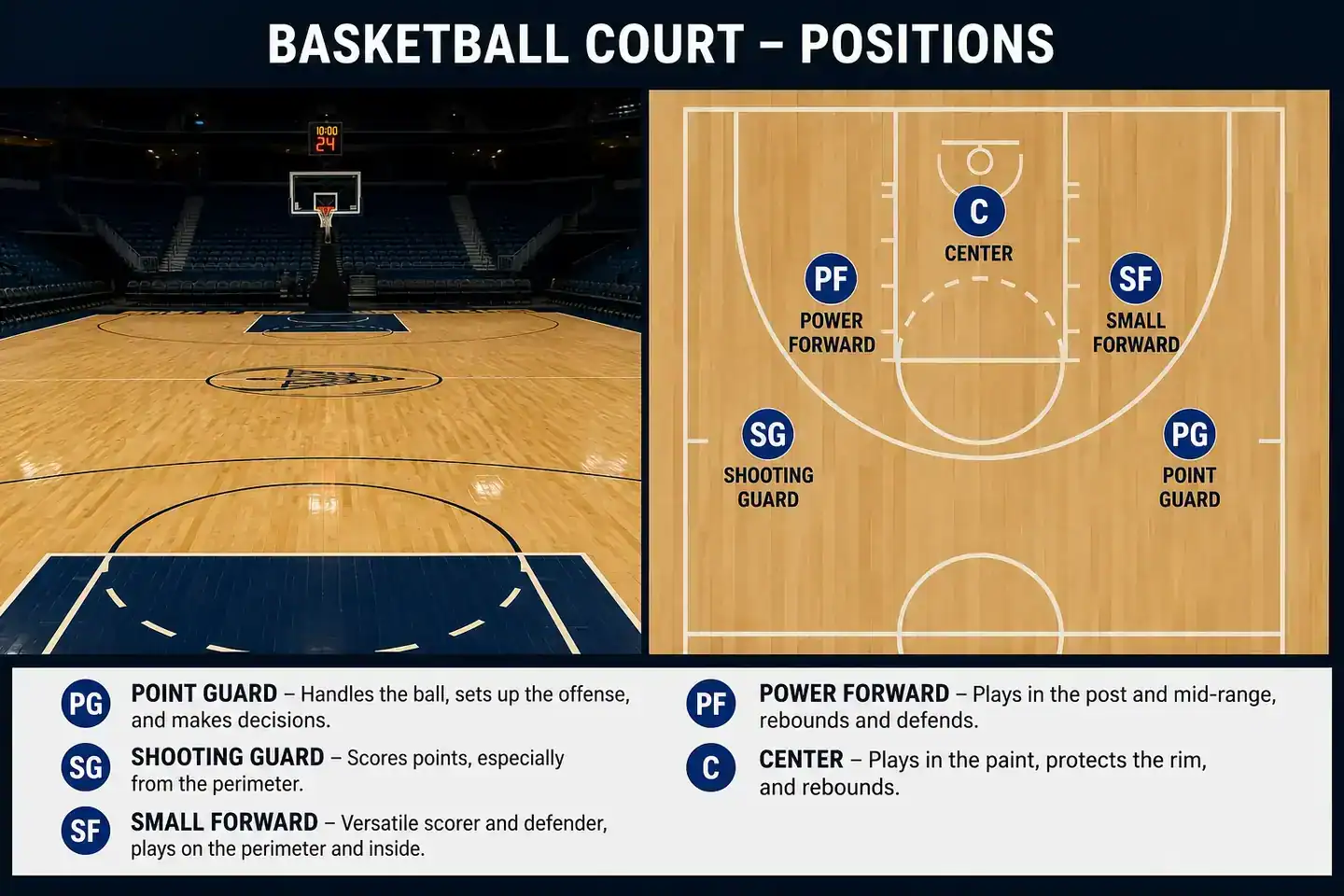
The five basketball positions and roles below run from smallest to biggest, which is also roughly how far from the basket each one plays.
Point Guard (PG)
The point guard brings the ball up the court and decides what the team does with it. Usually the shortest player on the floor, and the one making the most decisions. For this reason they’re also known as playmakers.
Main jobs:
- Handling the ball under pressure
- Seeing the whole court and finding the best teammate to pass the ball to
- Choosing quickly between passing, shooting and driving
Magic Johnson is the classic example. Stephen Curry changed the job by being his team’s best shooter as well as its playmaker. Caitlin Clark does something similar in the WNBA, shooting from far enough out that defences have to come and meet her.
Shooting Guard (SG)
Shooting guards are there to score, and most of their work happens without the ball. They run off screens, get open, and shoot as soon as the pass arrives. Many also handle the ball, so the point guard isn’t the only player who can start a play.
Main jobs:
- Shooting, both off the catch and off the dribble
- Moving without the ball to get open
- Defending the other team’s best guard
Michael Jordan and Kobe Bryant set the standard here. Anthony Edwards is the modern version: a high scorer who still defends properly.
Small Forward (SF)
The most flexible role on the court. Small forwards score from close range, mid-range and behind the three-point line, and they’re expected to defend almost anyone, from a quick guard to a much bigger forward.
Main jobs:
- Contributing in every area: scoring, passing and defending
- Using their athleticism to guard both small and big players
- Creating a shot when a play breaks down
Larry Bird played the position on his reading the game rather than pure athleticism. Kevin Durant is nearly seven feet tall and moves like a guard. Despite being mostly a small forward, LeBron James has been used at just about every position.
Power Forward (PF)
The power forward does the physical work: rebounding, setting screens and scoring near the basket. That’s still the heart of the job, but most modern power forwards are also asked to shoot from distance, which drags the opposing big man away from the rim.
Main jobs:
- Strength for rebounding and playing close to the basket
- Boxing out and winning rebounds at both ends
- Increasingly, shooting from three
Tim Duncan won titles playing it the traditional way. Kevin Garnett added a mid-range shot and could defend out on the perimeter. Giannis Antetokounmpo shows how loose the label has become – he’s listed as a forward and does whatever the game needs.
Centre (C)
The centre is usually the tallest player on the team and plays closest to the basket at both ends. In defence, that means blocking shots and rebounding. In attack, it means scoring from close range, setting screens for the guards and, more and more often, passing.
Main jobs:
- Protecting the basket and blocking shots
- Rebounding and boxing out
- Setting screens and passing out of them
Shaquille O’Neal overpowered people. Hakeem Olajuwon out-manoeuvred them. Nikola Jokić runs a whole offence from a position that used to just wait for the ball to arrive.
Basketball Positioning
Basketball positioning tells you where the players execute their role, and that changes every few seconds.
All of it comes down to space. The team with the ball is trying to open up a gap big enough to get a clear shot. The team without the ball is trying to close every gap down.
Offensive Basketball Positioning
The first job when attacking is to spread out. Five attackers standing close together are easy to defend, because one defender in the middle can watch two of them at once. If the attackers are spread around the edge of the court instead, every defender has to pick one opponent and stay with them.
Coaches call this spacing, and it’s the foundation of any attack. It’s also why you’ll often see a player standing alone in a corner: they’re there to hold a defender away from the basket.
The second job is to keep moving. A player who stands still is easy to guard, so attackers keep changing position to make a defender lose track of them for a moment, which is all it takes to get free.
The simplest version is a cut, where a player suddenly runs towards the basket. If the defender has turned his head to watch the ball and his man slips in behind his back, that’s a backdoor cut.
A screen does the same job without any running. One attacking player stays still right next to the defender who is marking a teammate, deliberately in the way. That teammate then runs past, and the defender is left stuck behind a stationary body. The screen only works if the player setting it stays completely still: moving into a defender gives away a foul.
There’s also a time limit on the best spot on the court. The rectangle painted on the floor in front of each basket is known as the paint, and an attacking player can’t stay inside it for more than three seconds. That’s why tall players drift in and out of it instead of standing next to the basket waiting for a pass.
Defensive Basketball Positioning
The basic rule of defending in basketball is simple: stay between the player you’re guarding and your own basket. The goal is to make sure that any shot the other player does take is a hard one. The rest of defending is about what happens when somebody fails to do it.
Remember the screen I mentioned before? The defender about to run into an attacker’s screen has two choices:
- The first is to fight their way round the attacker standing in the path. This costs a second or two, which is often long enough to lose the man the defender was supposed to be guarding.
- The second is to trade players (a concept called switching). The blocked defender takes over the attacker who set the screen, and the teammate who was guarding the screener takes over the player the blocked defender had been marking. Nobody is left unguarded, but it can end with a small guard marking a much taller player. Creating that mismatch is usually the whole point of the screen.
A different problem is a defender being beaten outright, with their marked player dribbling straight past towards the basket. Another defender has to abandon their own player and slide across to block the path, which is called help defence.
It stops the immediate danger and creates a new one, because the helper has now left somebody free. A third defender has to cover that player, which frees up a fourth. Most baskets are conceded somewhere along that chain rather than at the original mistake.
Positioning in Transition and Fast Breaks
When a team wins the ball and races to the other end before the defence can get back, that’s a fast break, also called transition. Positions barely matter here and filling space quickly becomes the top priority.
Usually one player carries the ball up the middle, two run wide down either side of the court, one sprints straight to the basket, and the last arrives a moment later for a shot from distance if the defence has crowded around the rim.
Defending has a fixed order of priority: stop the player with the ball first, protect the basket second, and find whoever you were originally guarding last. Teams that get that order the wrong way round tend to concede easy baskets.
Modern Basketball: Positionless Play and Hybrid Roles
The five positions I described still exist in today’s basketball, but the past decade has loosened what they mean. Positionless basketball is the term for line-ups built on skill rather than size, where all five players can more or less comfortably handle, pass and shoot, and defensive jobs are normally handed out by match-up instead of by position.
A few of the hybrid terms you’ll hear:
- Combo guard: a guard who can play either the 1 (point guard) or the 2 (shooting guard), running the offence one possession and scoring off the ball the next.
- Point forward: a forward who handles the ball, creates for teammates and attacks the basket, as LeBron James did for much of his career.
- Stretch four: a power forward who can shoot well from the three-point line, pulling the opposing big man away from the basket.
- Stretch five: the same idea, but this time it’s a centre who shoots from the three-point line, which forces the other team’s tallest defender out.
None of this has replaced the traditional set-up. Coaches still teach the five basketball player positions first, because the skills attached to them still have to be covered by somebody. Positionless basketball simply means that the roles are not handed out to players based on height alone any more.
This matters if you’re thinking of betting on the NBA and other basketball competitions. Two centres with the same job title can produce completely different numbers depending on whether their team asks them to shoot from distance or stay under the basket.
Frequently Asked Questions
What are the five basketball positions?
Point guard, shooting guard, small forward, power forward and centre. They’re numbered 1 to 5 in that order. Guards play out on the perimeter, forwards work in between, and the centre plays closest to the basket.
What do basketball positions 1–5 mean?
The numbers are shorthand. 1 is the point guard, 2 the shooting guard, 3 the small forward, 4 the power forward and 5 the centre. Coaches use them because plays are built around spots on the floor rather than particular players, so it’s easier and faster to just use numbers.
Which basketball position scores the most?
Guards and forwards usually top the scoring charts, mostly because they take the most shots. It isn’t a rule, though: Joel Embiid won the NBA scoring title twice in a row even though he’s a centre. A player’s role in the team decides it far more than the position label does.
Can basketball players play multiple positions?
Yes, and most of them do. Being able to cover two or three positions is one of the most valued qualities in the modern game. Terms like combo guard and point forward exist because so many players don’t fit neatly into one role.
Betting is only available to participants aged 18 years and over. Please bet responsibly. BeGambleAware.org