


Every rally and play burst in tennis is made up of different tennis shots. Each shot type serves a unique purpose. Some shots start at the point, others are used to develop a rally with patience from the back, while others help attack or defend under pressure as well as finish the point outright. A solid player rarely hits the same type of stroke twice in a row, because the situation is constantly changing. Thus, choosing the right response is as much part of a successful game as the technique behind it.
Understanding the main tennis shot types and tennis shot names makes the sport far easier to follow, whether you are picking up a racket yourself, watching from the stands, or catching a live TV broadcast. Our guide will explain the ideas behind shot grouping and how players usually pick which shot to play. Instead of just being a dry list of definitions, our guide will focus on the real practical uses for shots, so the next rally you see makes more sense.
What are Tennis Shots?
In simple terms, a tennis shot is any strike of the ball during play. The term ‘tennis strokes’, strictly speaking, defines the underlying swing motion and technique that produces a shot. Thus, the forehand is a stroke, while a forehand winner is a shot played using that particular stroke.
While in everyday language the two terms (stroke & shot) are used interchangeably, this guide will keep the distinction in mind.
Why do Different Types of Tennis Shots Exist?
That’s because every sport is dynamic, and tennis is especially unique because every other shot can present an entirely new set of problems for the intended recipient. If a ball is set to land at your feet, the response is going to be different compared to what you may do when receiving a floating volley high above the net.
An opponent charging forward demands a different response than one pinned behind the baseline. Each tennis shot is a tool that’s designed to tackle specific situations. There are power options, spins, touches and height variations which the best players are able to use to their advantage.
Constant Variations
Professional and high-level semi-pro players rarely use the same shot again and again. Doing so makes them predictable, and a predictable opponent is easier to counter.
Instead, the selection of tennis shots always shifts during a rally. A player might open things up with a defensive choice to buy time and develop, while probing for an opening. Once they sense a vulnerability, they can finish with a crisp volley. As the ball’s height, depth, speed and angle change with every strike, so does the player’s shot choice. The ongoing decision-making process is at the heart of every match, and making the correct picks can greatly increase the likelihood of a victory.
How Tennis Shots are Classified?
Since there are quite a handful of different strokes, it’s much easier to remember and understand the 4 broad categories of tennis shots. Grouping the main tennis shots types this way means almost every single shot you will ever see falls into one of the 4 groups. Please find the information in the table below:
| Category | Purpose |
| Groundstrokes | Rally from the baseline — the backbone of most points |
| Volleys | Played close to the net, usually to finish or pressure |
| Serves | Start every point; the only shot fully under a player’s control |
| Specialty shots | Attack, defend or change the rhythm of a rally |
These groups can overlap. A Specialty shot like a smash is played near the net, and a serve is technically a category all on its own. However, this simple categorisation can provide you with a mental map that’s easy to follow. The sections below break down each category of tennis shots types in more detail.
Groundstrokes
Groundstrokes are the most common shots in tennis. They’re played after the ball has bounced, usually from around the baseline.
Because the vast majority of shots in a typical rally are groundstrokes, they form the foundation of all the players’ game. There are two distinct types of groundstrokes that we must cover.
Forehand
The forehand is struck on the dominant side of the body — the right side for a right-hander. For most players, this is the more powerful and natural of the two options, often used as the main attacking weapon.
Backhand
This one is played from the opposite side, and has two variations: one-handed and two-handed. For most athletes, the backhand is the more controlled shot, though in the last decade or so, we see more and more top men and women hit it every bit as aggressively as their forehand.
Spin Type
The ‘Groundstroke tennis shots list’ is also defined and distinguished by the type of spin applied to the ball.
- Topspin – brushing the racket up the back of the ball. The ball dips down into the court and kicks up on the bounce. It allows the player to swing hard, but remain in control. It’s the staple of a modern baseline game.
- Slice – direct cut underneath the ball. With the slice, the ball stays low and floats. It’s a great choice for changing the pace and getting out of situations where the rally’s control might be slipping away.
- Flat – hit with little spin. It’s a fast shot with maximum power, and a very direct attack. However, the flat groundstroke leaves almost no room for error.
Offensive vs Defensive
As a final differentiator, groundstrokes are separated into offensive and defensive ones. An offensive option is hit harder and earlier to seize control or force an error. On the other hand, a defensive slice or deep ball is more about buying time and survival when the player wants to recover court position when it’s compromised.
Skilled players constantly change direction with their groundstrokes too. They’re able to redirect the ball down the line or cross-court to move an opponent around. This opens up space.
Volley Shots
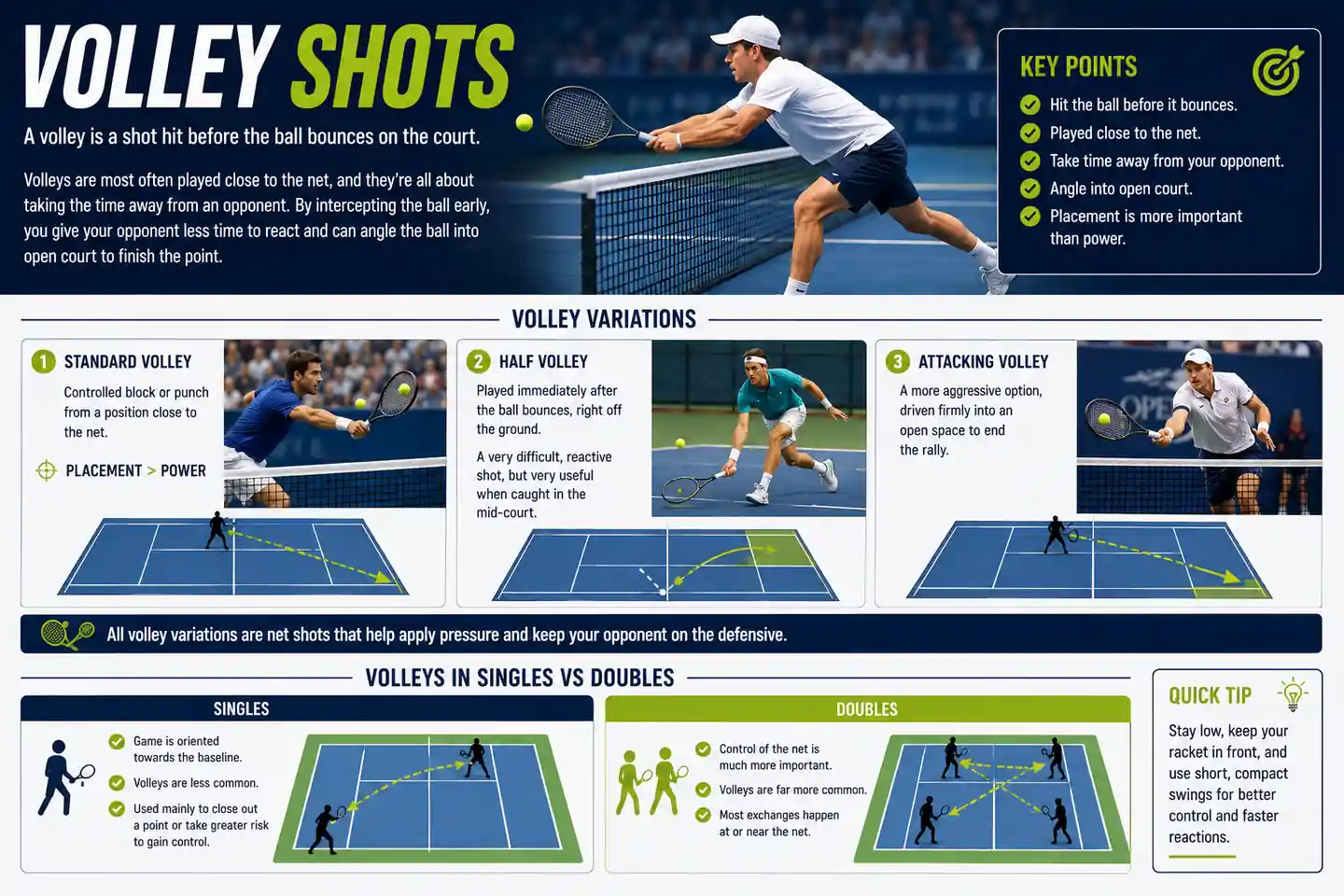
This is the shot that’s hit before the ball bounces on the court. Volleys are most often played close to the net, and they’re all about taking the time away from an opponent. You can perform a volley by intercepting the ball early, and since the player is at the net, this gives the opponent less time to react. It’s easier to angle the ball into open court to finish a point in such situations.
Volley Variations
The classification of tennis volley shots has a few broad variations.
- Standard Volley – controlled block or punch that comes from a position that’s close to the net. Placement > Power.
- Half Volley – played immediately after the ball bounces, right off the ground. It is a very difficult, reactive shot to pull off, but can be mighty useful when a player is caught in the mid-court.
- Attacking Volley – more aggressive option, driven firmly into an open space to end the rally.
The one common theme amongst these variations is that they are all net shots that help apply pressure.
Volleys in Singles vs Doubles Tennis
Volleys are far more common in doubles than in singles. When there are two players on each side, the control of the net is much more lucrative and important. Thus, volleys dominate most exchanges in doubles.
In singles, the game is much more oriented towards the baseline, so volleys are a rarer occurrence. They’re typically utilised when a player approaches the net to close out a point or when they take greater risk in order to obtain control.
Tennis Serve Types
In tennis, the serve is the shot that starts every point. It’s also the only time when a player (in this case – the server) can hit a ball entirely on their own terms. The opponent has to react, meaning servers have the freedom to vary deliveries.
Most serve deliveries are adjusted through 3 separate levers: speed, spin and placement. Varying each lever keeps the returner guessing and helps them take advantage of the situation. Here are the types of serve tennis shots:
- Flat – raw speed. It’s the classic weapon for going after quick points.
- Slice – curves sideways through the air. It drags the returner off the court to force them into uncomfortable returns.
- Kick – heavy on the topspin. Kick serves clear the net with ease and bounce up high and awkwardly.
The goal for every player is to mix things up. This prevents the opponent from getting into a rhythm on their returns.
The most apparent contrast in serving strategy is evident in the first and second serves contrast. The first serve is usually the more aggressive one, since the miss only costs the attempt, not the point. The second one already poses the risk of a double fault, meaning players are more conservative and try to have the ball land in.
If you want to read about serves and their types in greater detail, look at our Tennis Serve Rules and Types guide.
Speciality Tennis Shots
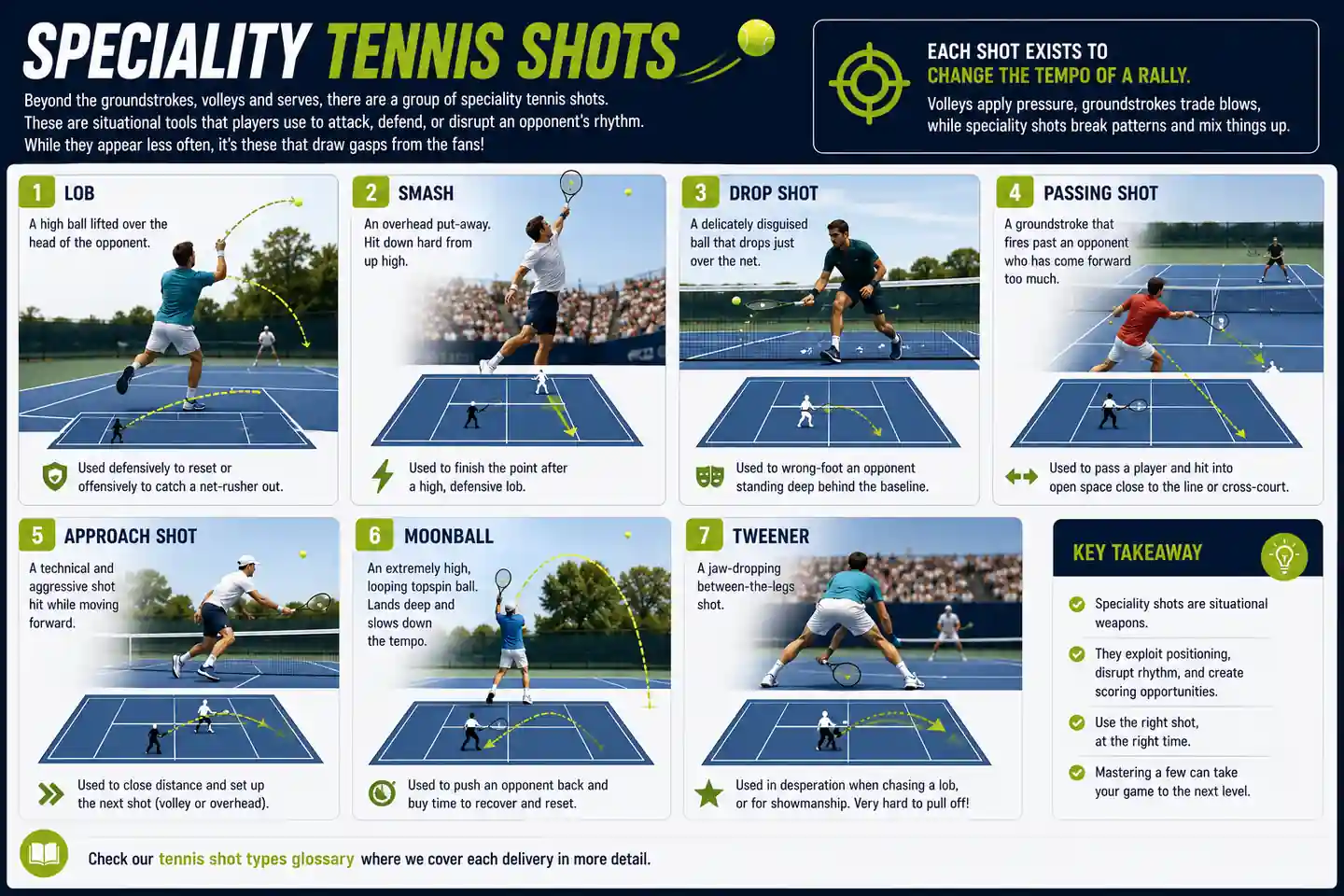
Beyond the groundstrokes, volleys and serves, there are a group of speciality tennis shots. These are situational tools that players use to attack, defend, or disrupt an opponent’s rhythm. While they appear less often than the aforementioned tennis shot types, it’s these that draw gasps from the fans. This is the part of any tennis shots list where the tennis shots names get more colourful — common examples include the:
- Lob – a high ball lifted over the head of the opponent. It’s used both defensively (reset when stretched) and offensively (catch a net-rusher out).
- Smash – an overhead put-away. It’s hit down hard from up high, typically being the answer to a sloppy lob.
- Drop shot – a delicately disguised ball that drops just over the net. It’s a design choice which seeks to wrong-foot an opponent who’s stationed deep behind the baseline.
- Passing shot – a groundstroke that fires past the recipient who has come forward too much. The ball threads beyond their reach, landing close to the line or cross-court.
- Approach shot – a technical and aggressive type of shot, hit when moving forward. It’s usually used to set up the next move instead of aiming to win the point right there and now.
- Moonball – an extremely high, looping topspin ball. It lands deep and slows down the tempo. It’s often the chosen counter against aggressive pushes and buys recovery time.
- Tweener – it’s a jaw-dropping between-the-legs shot. Usually played in desperation, when chasing down a lob, or out of pure showmanship. It’s a lob with the back to the net but is a very hard option to convert.
Each shot exists to change the tempo of a rally. Volleys apply pressure, groundstrokes trade blows, while speciality shots break patterns and mix things up. Players typically rely on speciality shots to exploit an opponent’s positional weakness or to reduce pressure. Check our tennis shot types glossary, where we cover each delivery in more detail.
How Players Choose the Right Tennis Shot?
Since there are so many options and variables, choosing which shot to play is a split-second decision, made afresh with every single ball. Rather than just being all about mechanics, it’s also about tactics. Athletes read the situation and pick what’s in their mind the response with the highest chance to win, or at least improve the point. Several things help factor the decision:
- Incoming ball – the height, speed, spin and angle of the ball that’s coming in will dictate what’s even possible. If it’s a low, fast ball, for example, an easy attack is ruled out, whereas a short, high one invites it.
- Court position – if you’re stretched wide, you often are limited to defensive and reset-type shots. If you’re in a solid position inside the baseline, you can attack.
- Opponent’s position – if the opponent is at the net, this may call for a lob or a passing shot. If they’re pinned deep, they’re more vulnerable to a drop shot.
- Score and situation – if it’s a big point, you might see a player choosing a tad more conservative, higher-percentage shots over the more spectacular ones. Big-time pros usually manage risk, depending on the importance of the point.
- Overall strengths and weaknesses – players will always try to steer the ball towards their best shots and target whatever their opponent struggles with. The goal is to engineer as many rallies that favour them as possible.
- Surface and conditions – a faster, low-bounce court rewards flat, aggressive shots way more than a slower, high-bouncing one, and vice versa.
All top players process most, if not all, of these factors instinctively, which is why elite tennis sometimes looks effortless. The shot that appears obvious in hindsight was chosen in a fraction of a second from a dozen possibilities. This is why good shot selection in tennis matters just as much as it does in sports like football or basketball. It’s often what separates good and great players.
Why Understanding Tennis Shots Matters?
Recognising the different tennis shots transforms how you experience the game. Once you can tell a topspin groundstroke from a simple slice, or know when it’s a passing or an approach shot, matches will become easier and more enjoyable to follow. You can understand the patterns, intentions and ideas behind every shot, rather than just watching the ball bounce back and forth.
This knowledge of tactics can also make on-screen and advanced statistics as well as commentary far more meaningful. You can start to make associations about why a player has more winners, unforced errors or net points won. Everything starts to make more sense when you know the vocabulary.
Side Note on Tennis Betting
For avid followers of the sport, knowing the details behind most shot types sharpens the reading of tennis betting markets, too. Understanding how a player’s shot-making suits a given surface or matchup — a big server on a fast court, a defensive counter-puncher on slow clay- can be useful context when weighing your options. In short, knowledge transforms you from a casual fan into someone who genuinely reads the game and can make more informed bets.
FAQ
What are the Main Tennis Shots?
The main shot types fall into 4 groups: groundstrokes, volleys, serves and speciality shots. Groundstrokes are the most common in a typical rally, while the speciality tennis shots list is expansive, and they’re the most difficult to master.
How Many Tennis Strokes are There?
There isn’t any fixed number that would encompass all tennis strokes. The core strokes are: forehand, backhand, the serve and the volley. From these, players also develop many variations like topspin, slice, and flat, plus speciality shots. So, the fundamental strokes actually produce a wider range of shots in practice.
What is the Difference Between Tennis Shots and Tennis Strokes?
A stroke is the underlying technique or the swing, while the shot is that technique applied. For example, the forehand is a stroke, while a forehand winner is a shot that was played with that stroke.
Which Tennis Shot is Used Most Often?
That would be the groundstroke, and by a wide margin. Because most rallies are played from around the baseline, backhands and forehands will make up the large majority of shots.
Why do Players Use Different Shots During a Rally?
That’s because the situation is continuously evolving with every shot. The height, speed and placement of the incoming shot, players’ positions, match situation and a variety of other factors dictate the best response.
Betting is only available to participants above 18 years. Please bet responsibly. BeGambleAware.org