



Tennis has one of the most distinctive scoring systems in all sports. Where most sports count specific points upwards (1, 2, 3…) – tennis uses its own language of: love, 15, 30 and 40, played across points, games and sets that make up the match. While newcomers may be a bit baffled by the terminology at first, the reality is a bit less head-scratching. The tennis scoring rules follow a clear, logical structure once you understand how the pieces fit together.
In this post, we’ll explain how the hierarchy of scoring rules actually works, why tennis counts the way it does, and how tie-breaks decide tight sets. In addition, we’ll also gloss over essential differences in rules between singles and doubles tennis. This is written for beginners and casual fans, so they can better understand this sport. It’s important for both fans and tennis betting participants over 18.
How Do Tennis Scoring Rules Work?
If you were to compare tennis with any other sport, the scoring system immediately feels different. If you have ever wondered how does tennis scoring work, the key is to think of it as a series of nested stages, each one building on the last. Every single match is made up of 4 levels, from the smallest to the largest. The table below should be very useful in explaining it:
| Unit | What it means |
| Point | The smallest unit of scoring. Instead of 1, 2, 3 and 4, points in tennis are called 15, 30, 40 and ‘Game’. Points make up a game. |
| Game | Won by the first player to 4 points, provided they lead by two. Games make up a set. |
| Set | Usually won by the first player to 6 games, provided they lead by two. Can go into tie-break. Sets make up a match. |
| Match | Won by the first player to take the required number of sets — two in best-of-three, three in best-of-five. |
The logic here is simple:
- Players try to get points to win a game
- Games are needed to win a set
- A total of 2 or 3 set wins are needed to win the match
It’s interesting to know that tennis scoring rules create some unique predicaments for outcomes. For example, a player can even win more total points than their opponent over the course of a match and still lose, because it is not the raw number of points that matters but when and where you win them.
Every official match follows this structure, regardless of the surface or the tournament it belongs to. The only things that change include the number of possible sets, the type of tie-break and the line rules.
Tennis Point Scoring Explained
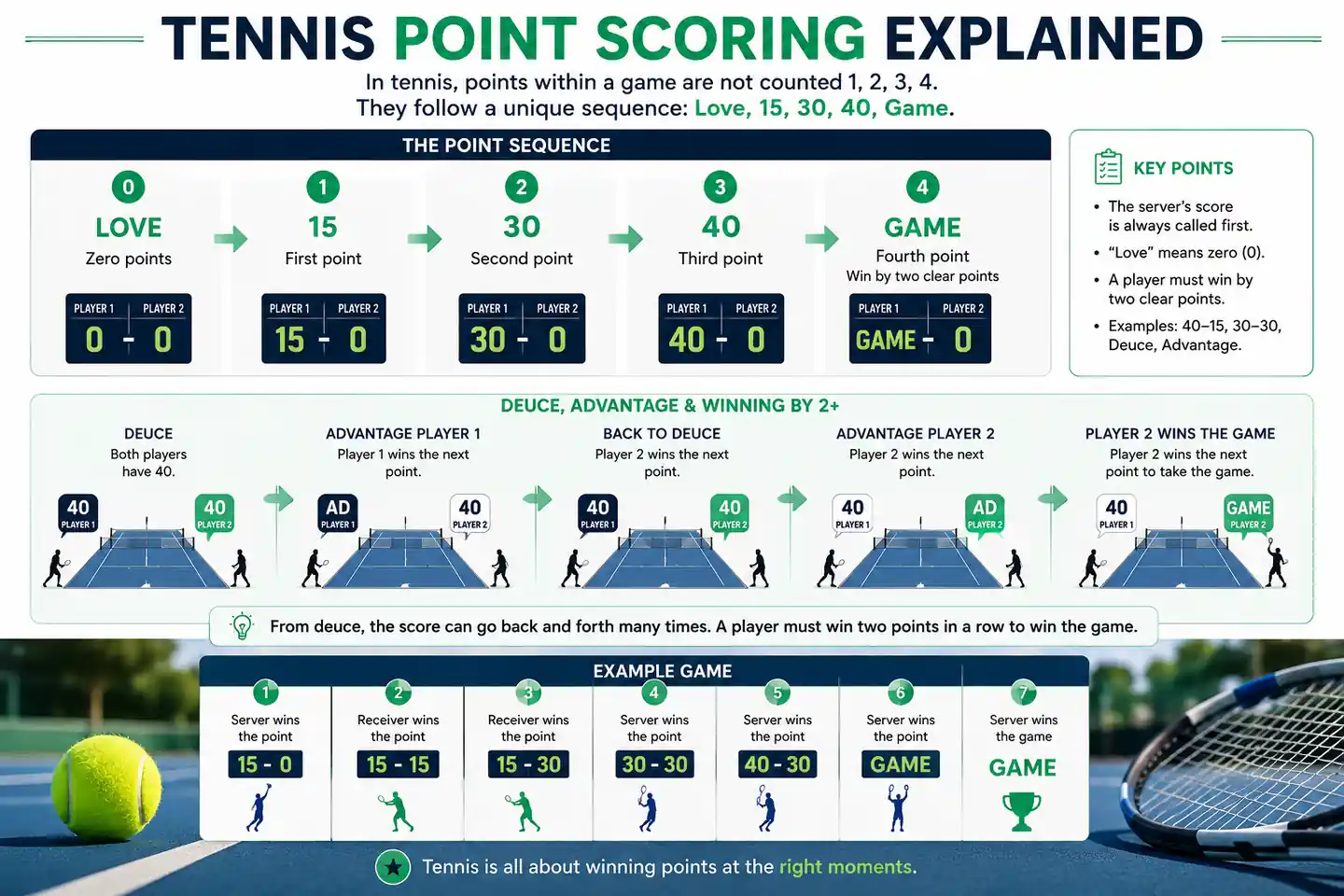
The most unique, and probably the most confusing part of the system regards how individual points are counted within the game. As we touched on in the table above, tennis has its own sequence instead of 1 -> 2 -> 3 -> 4. Here’s how the calls differ:
| Points won | Called as |
| 0 points | Love |
| 1st point | 15 |
| 2nd point | 30 |
| 3rd point | 40 |
| 4th point | Game (if two points ahead) or Tie-Break (if the margin isn’t enough) |
So, a player’s first point will take them to 15 on the scoreboard. Then it moves to 30, then to 40, and a fourth point would result in a game win, as long as they’re at least two points clear. ‘Love’ is a term you can also often hear from the umpires (referees). It simply means zero (0).
This scoring system is said to have originated from France and medieval clock faces.
It’s also worth knowing that the announcer will always say the server’s tally first, so ‘30–15’ means the server has 30 and the receiver has 15.
Deuce, Advantage and Winning by 2+
In order to fully understand how does tennis scoring work, one must also have a clear understanding of the catches within the rules. For example, you can only win a game by two clear points. This predicament creates unique scoring situations that must be known, since the announcers call them quite often:
- Deuce – when both players are level on 40
- Advantage (AD) – the next player to win a point from a ‘Deuce’ gets an advantage
If the player with the advantage wins the following point too, they take the game. However, if they lose with the advantage, the scoring returns to deuce, and the process repeats.
This means that the game can swing back and forth through deuces and advantages many times before someone finally pulls through. This is one of the elements that can make tennis matches so intense. A player who wins a point from the receiving position, incidentally, may create a break point — the chance to win a game against the serve (while returning), which is one of the turning points of any match.
Example Game
To help our readers get a clearer picture of tennis scoring rules, here’s an example of a straightforward game:
| Who wins the point | Score (server first) | Situation |
| Server wins | 15–0 | Server leads by one point |
| Receiver wins | 15–15 | Score is level |
| Receiver wins | 15–30 | Receiver jumps to a lead |
| Server wins | 30–30 | Score is level again |
| Server wins | 40–30 | Server is one point from ‘Game’ |
| Server wins | Game | Server takes the game |
In this example, had the returner won while trailing 40-30, the game would’ve moved into a Deuce, meaning continuation until someone leads by 2+.
How Games Become Sets?
In tennis, sets consist of games – just as we explained in the table above, in the ‘How Do Tennis Scoring Rules Work?’ paragraph. A set is normally won by the player who is the first to reach 6 games. However, just as with points in the game, they must be ahead by at least 2 games to win a set.
Tennis scoring rules dictate that a scoreline of 6-4 or 6-3, for example, wins the set cleanly, but it gets more interesting when the scores are closer.
If the score is 5-5, neither player can win 6-5 because it’s only a 1-game lead. Instead, the set continues with another game. The leading player can win 7-5 if they take another set. Alternatively, if the score becomes 6-6, this is where the tie-break comes in. This element of the game will be explained in the next paragraph.
Some Examples of Set Scorelines
A few common winning set scores make the pattern clear:
- 6-3 – a 3-game margin, set won
- 6-4 – a 2-game margin, set won
- 7–5 – set was level at 5-5, and one player won the next two games to win the set
- 7–6 – set was level at 6-6 and got settled by a tie-break
What is a Tie-Break?
A Tie-Break is one of the most anticipated and intense moments that can occur within a tennis match. It’s a situation that happens when a set reaches 6-6. Rather than continuing to play regular games indefinitely, the Tie-Break provides a clear way to settle things. The scoring is transformed into numericals for the time being, rather than the 15/30/40 system.
In non-Grand-Slam tournaments, the first player to reach 7 points in a Tie-Break wins (provided they have a 2+ point advantage). The player who wins the tie-break takes the set 7-6, which is the score that’s put on the board. During the Tie-Break, players serve in alternating fashion via a set pattern. They also change ends at regular intervals to keep conditions as fair as possible.
In Grand Slam tournaments, the Tie-Break is longer and played until 10 points. The longer format is also used in many doubles events.
How Do You Win a Tennis Match?
A match is won by taking a set majority, but the final number depends on the format. There are two main formats to get to know in tennis scoring rules:
- Best of 3 – the first player or team to win 2 sets wins the match. Standard across most pro tour events, and is used for all Women’s singles matches and the majority of Men’s events.
- Best of 5 – the first player to win 3 sets wins the match. This is the format used for Men’s singles events at Grand Slam tournaments: the Australian Open, French Open, Wimbledon and the US Open.
| Best of Three | Best of Five | |
| Sets to win | 2 (best of 3) | 3 (best of 5) |
| Maximum sets | 3 | 5 |
| Typical length | 1.5 – 3 hours | 3 – 5 hours |
| Commonly used in | Most ATP and WTA tour events; all Women’s matches | Men’s singles at the Grand Slams |
Because best-of-5 requires more sets to win, these matches can run considerably longer. Factor in a slower surface (clay), and you can often see competitive Men’s Singles matches at the French Open run well over 4 hours.
Tennis Rules for Singles
Let’s get to know the tennis rules for the singles format. This one-against-one game is what most people picture. Here are the essentials:
- One player per side – each competitor is responsible for the entire court on their side. No partners.
- Court dimensions – the singles court is 23.77 m (78 ft) long and 8.23 m (27 ft) wide. In the singles games, inner sidelines are used. The narrow tramlines down each side are considered out of bounds.
- Serving – the server begins play from behind the baseline. They serve diagonally into the opponent’s service box. They get 2 attempts to make a successful serve. If they make 2 consecutive faults, it’s a double fault, and the point is conceded.
- Alternate serving – players serve for a whole game at a time and take turns. One player serves first, and the other does it for the next game, and so on.
- Change of ends – players switch their ends of the court after the 1st game. This change happens again each time thereafter on every odd-numbered game (so on 1st, 3rd, 5th, 7th and so on). This is done to balance out sun, wind, or other disadvantages.
- Scoring – singles uses the standard points, games and sets system described above, including deuce and advantage.
- In and out boundaries – balls need to land inside the boundary lines for the point to count. If any part of the ball is on the boundary line, that counts (‘In’). However, if a ball lands entirely beyond the line (‘Out’), the point is lost.
It’s crucial to know how important serves are to the Singles game. A clean, unreturned serve is called an ace. Understanding the mechanics of the serve — and the two-attempt rule that goes with it — is one of the quickest ways to make sense of how points begin and end.
Tennis Doubles Rules
The tennis doubles rules cover the two-against-two game. During a doubles match, each side has a team of two players. There can be Men’s doubles, Women’s doubles or even mixed doubles, where one player is Male, and the other is Female. In doubles tennis, the scoring of points, games and sets is the same as in singles, but the wider court and the presence of a partner add several important differences.
- Two players per team – adds an element of cooperation.
- The Court – the doubles court is wider (10.97 m or 36 ft), and uses the full width, including the tramlines. The length is the same.
- Tramlines – there are narrow lanes down each side of the court. They are playable (‘In’) in doubles, which is why the court is wider.
- Serving rotation – tennis doubles rules dictate that serving rotates between all 4 participants. There’s a fixed order, agreed at the start of each set. Each of the 4 players serves one game over four consecutive service games.
- Receiving rotation – each player in the team chooses a side of the court to stay and receive on. There’s the deuce side (right) or the advantage side (left). The player must stay on their designated side for the entire set.
- Partner positioning – typically, the play starts with one player near the net and the other nearer to the baseline. Both can also be back deeper, adjusting tactically. Court positioning is one of the keys to success in doubles tennis.
- Communication – both players are in constant verbal and non-verbal communication to avoid confusion and take advantage of the extra court width.
Doubles also frequently employ two scoring variations to save time.
First, there’s usually no-ad scoring, so tied games (40-40) become sudden death rather than playing until there’s a 2-point margin. The receiving team chooses which side to receive from.
Second, instead of a full 3rd set, a lot of doubles matches will play a 10-point Tie-break as the decider. These rules make doubles matches a tad shorter than most singles affairs.
Singles vs Doubles: What’s the Difference?
Although the core tennis scoring rules in both singles and doubles tennis are identical, there are several practical differences. The table below summarises these key contrasts at a glance:
| Feature | Singles | Doubles |
| Players | 1 per side | 2 per side (a team) |
| Court width | Narrower — 27 feet (8.23 m) | Wider — 36 feet (10.97 m) |
| Court lines | Inner sidelines; tramlines are out | Outer sidelines; tramlines are in play |
| Serving order | Players alternate service games | Teams rotate serve for all 4 players |
| Receiving | Receiver returns from either side as required | Each partner holds one return side for the set |
| Typical match format | Best of 3 (best of 5 for men at Slams) | Best of 3, often with no-ad games and a match tie-break decider |
So, while the way you score points, games and sets stays the same in both formats, the size of the playing area, number of people on the court and the organisation of serving and receiving, plus the doubles shortcuts – all change.
FAQ
Why is Tennis Scored 15, 30 and 40?
The popular explanation is that the scoring originated from the face of French clocks, with points marked at the quarter-hours. However, over time, ‘45’ became shortened to ‘40’ for ease of calling and to accommodate the ‘advantage’ system. The precise history is debatable, but this explanation is the most widespread.
What Does ‘Love’ Mean in Tennis?
‘Love’ simply means a score of zero. A game that starts at 0–0 is called ‘love–all’, and winning a game without conceding a point is winning it ‘to love’. One popular theory links the term to the French ‘l’œuf’ (‘the egg’, for the zero shape), though this too is debated.
How Many Points Win a Game?
Players need at least four points to win a game according to how tennis scoring works. However, singles players must also be clear by 2+ points. In doubles tennis, there’s no-advantage scoring, so a 40-40 tie game is sudden death, decided by a single point.
What Happens at Deuce?
If the score reaches deuce (40-40), one point creates an advantage situation, while another one is needed to win the game. Thus, the play continues until one player manages to take a two-point lead, effectively ending the game.
How Many Sets are Played in a Tennis Match?
The answer depends on the format. Best-of-3 matches are won by the first player to 2 sets. It’s the most common format across the tour, including non-slam men’s events, all women’s tournaments and most doubles events. Best-of-5 matches are won by the first to 3 sets and are used for men’s singles at the Grand Slams.
Betting is only available to participants above 18 years. Please bet responsibly. BeGambleAware.org